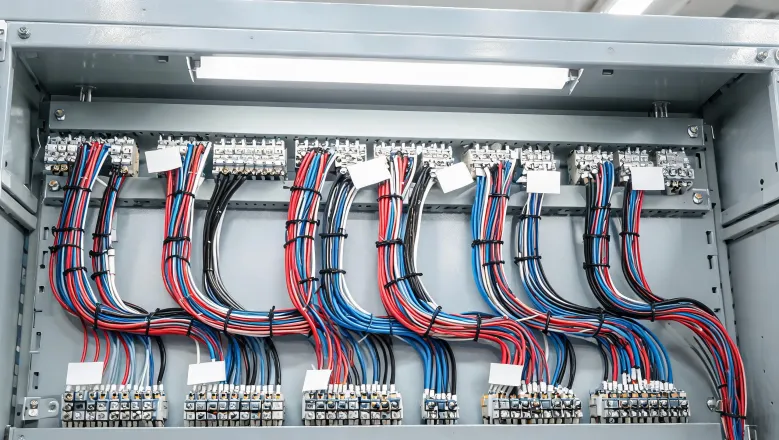
The request I thought was simple
On a Tuesday morning in March 2024, our facilities manager dropped by my desk with his phone out. "The drive on the air handler is flashing something. Can you pull the manual and tell me what code 4 is? I think we've got a bad—" He trailed off, then added, "And can you run a current check with the multimeter?"
I'm the office administrator here. I manage procurement for a 120-person operation—office supplies, janitorial contracts, breakroom appliances, and whatever the maintenance team needs. My title says "administrator." My actual job often says "figure it out."
So I said yes. I opened Google and typed danfoss vfd error codes. Then I pulled up what I thought was the right danfoss vfd parameter setting pdf. Somewhere in that search I also found a Kenmore control panel diagram (unclear why), a product listing for a control panel label kit, and a how-to video on testing current with a multimeter.
I felt productive. I was not.
What was actually going wrong (it wasn't the drive)
Here's what I didn't understand at the time: I wasn't solving a Danfoss VFD problem. I was solving my own problem—a procurement problem—and I was wearing the wrong hat to do it.
The maintenance team needed a licensed electrician with VFD experience. What they got was an administrator with a search engine and a multimeter (unfortunately, a basic one—not a clamp meter, which is what you actually need for most current checks on live motor circuits). I found that out later.)
It took me three years and roughly 40 maintenance-related orders to understand that the admin's job isn't to diagnose the drive. The admin's job is to get the right person on-site faster than they would have arrived on their own.
I said "I'll find the manual." They heard "I'll tell you what's wrong." Result: I sent them a parameter list from the wrong model line (FC 51, not FC 102), they cross-referenced it against error code 4, misread it, ordered a $380 control panel that didn't fit, and the air handler sat idle for six hours while we sorted it out.
That's the part nobody tells you about the danfoss-vfd learning curve. It's not the technical depth that trips you up. It's the assumption that technical depth is what's being asked of you.
What it cost us (and me)
The $380 panel was the visible cost. The invisible cost was worse.
Our HVAC contractor charges $145/hour for emergency escalation. We paid four hours of that ($580) to recover from a problem that would have been a routine $200 service call if I'd just picked up the phone on Monday. Between the wrong panel, the emergency dispatch, and the time our operations supervisor spent babysitting the air handler, we were out around $1,200.
And I looked bad. Not in a dramatic way—nobody yelled. But when the facilities manager started copying our finance director on maintenance requests, I got the message.
I've come to believe that most admin procurement mistakes aren't about buying the wrong thing. They're about buying for the wrong reason. I bought a control panel because the error code felt like a puzzle I could solve. What I should have bought was a qualified technician's time, and I should have bought it two days earlier.
The rule I use now
I don't troubleshoot drives anymore. What I do instead looks like this:
I keep a short list of approved vendors for electrical equipment—not just Danfoss parts, but licensed service providers. Any VFD-related request, whether it's an error code, a parameter reset, or a physical part, goes to one of those vendors first. Not to Google, not to me. Most of them will do a phone consult for free—they quote faster when they know you're a repeat customer.
I ask for three things before I place any VFD-related order: the exact model number (not "the Danfoss one"), the exact fault code, and confirmation that the person requesting it is licensed to work on it. If they can't give me the model number, I call the vendor and ask them how to find it. That's $0 and takes ten minutes.
I never touch a multimeter on a live circuit again. That's not a skill I'm going to build. It's a liability I'm not insured for. If someone needs a current test, I schedule an electrician. (I keep the multimeter in the supply cabinet, but it's for checking batteries and continuity—not 480V motor drives.)
The Kenmore control panel situation, for what it's worth, turned out to be a completely separate request from the breakroom refrigerator. Nothing to do with the Danfoss drive. I just got them blended together because they both said "control panel" and my search history reflected that. Two different pieces of equipment. Two completely different parts. Same words.
The part I still get wrong
I still occasionally pull a manual just to be helpful. Old habit. But now I hand it off with "this is for your reference—I'm not interpreting it." That distinction matters more than I expected.
If you're an admin and someone asks you to look up a danfoss vfd error code, my advice is: look it up, don't act on it. Find the manual—the actual manual for the actual model. Pass it along. Then call the vendor.
The best thing I ever did for our maintenance team wasn't learning to read fault codes. It was admitting, out loud, that I couldn't.