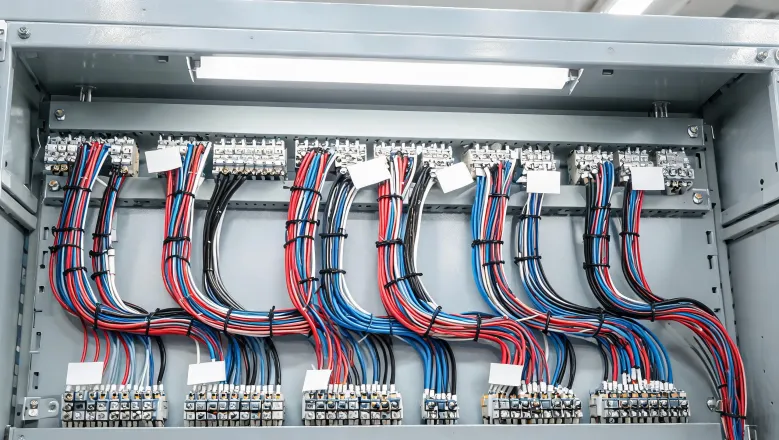
If you're sourcing Panduit cable ties, Panduit cable tie mounts, or enclosure OEM components, the biggest mistake is treating them as simple commodity purchases. After documenting $12,000 in wasted budget from five significant errors, I can tell you: the lowest unit price almost never means the lowest total cost. Focus on enclosure specifications, total cost of ownership, and a pre-order checklist. That's the bottom line.
I'm a procurement manager handling electrical enclosure and cable management orders for 8 years. I've personally made (and documented) 5 significant mistakes, totaling roughly $12,000 in wasted budget. Now I maintain our team's checklist to prevent others from repeating my errors. This isn't theoretical—every number below comes from a real order that went wrong.
Why You Should Trust My Mistakes
In my first year (2017), I made the classic mistake of ordering enclosures based only on dimensions, ignoring NEMA ratings. The units failed in an outdoor test within weeks. That error cost $3,200 in redo plus a 1-week delay. In September 2022, a cable tie specification error led to a $1,800 loss on a 5,000-piece order. And just last year, an incomplete enclosure specification sheet for an OEM custom job resulted in 500 boxes that couldn't be assembled—$4,500 straight to the scrap pile.
I don't have hard data on industry-wide error rates, but based on our 8 years of orders, my sense is that at least 1 in 5 first-time enclosure OEM orders has some kind of spec mismatch. I wish I had tracked this more carefully from the start. What I can say anecdotally is that a simple checklist would have caught four out of my five mistakes.
“The wrong Panduit cable tie on a high-temp application doesn't just break—it melts, and then you're explaining to the customer why their control panel failed.”
The Five Costly Mistakes I Made (So You Don't Have To)
Mistake 1: Ignoring NEMA Ratings and Material Compatibility
In 2017, I ordered 20 enclosures for an outdoor telecom project. I checked the dimensions, the mounting holes, and the price. I didn't check the NEMA rating. I assumed "outdoor" meant any metal box would work. Three months later, the enclosures were rusting, and water had gotten inside. We had to replace all 20 units. Cost: $3,200 plus a week of downtime.
Lesson: Always verify the NEMA 250 rating. Type 1 is for indoor use only. Type 3R is rain-tight. Type 4X is watertight and corrosion-resistant. According to NEMA 250, these ratings are not interchangeable. If you're buying enclosure wholesale, make the rating the first line of your spec.
Mistake 2: Assuming All Panduit Cable Ties Are the Same
In 2022, we had a rush order for control panels that would operate near a furnace. The ambient temperature was around 90°C (194°F). I grabbed our standard nylon 6.6 cable ties—they were cheap and in stock. I didn't check the temperature rating. Standard nylon ties are typically rated for -40°C to 85°C. At 90°C, they become brittle and break. We lost 5,000 ties and had to rework the panels. Cost: $1,800 in materials and labor.
Lesson: Panduit offers cable ties in different materials: nylon 6.6 (general purpose), heat-stabilized nylon (up to 105°C), and stainless steel (up to 538°C). Always check the operating temperature range. Also, don't forget Panduit cable tie mounts—they have their own adhesive and temperature limits. According to Panduit's official catalog, their nylon 6.6 ties have tensile strengths from 18 lb to 250 lb, but that strength drops in high heat.
Mistake 3: Incomplete Enclosure Specifications for OEM Orders
Last year, we placed a custom enclosure OEM order for 500 junction boxes. The spec sheet had dimensions, material (14-gauge steel), and color (gray). It did not specify tolerances, surface finish, or the exact position of the mounting holes. The supplier interpreted "gray" as a different shade, and the holes were off by 3mm. The boxes didn't fit the pre-drilled backplates. We couldn't use any of them. Cost: $4,500 plus a 3-week delay.
Lesson: Use a standardized enclosure specification template. Include: dimensions with tolerances (±0.5mm), material grade, finish (e.g., powder coat, RAL number), hole sizes and positions, and any certifications (UL, CSA, NEMA). A 10-minute template check would have saved us $4,500.
Mistake 4: Forgetting the Installation Tooling Cost
This one was subtle. I compared Panduit cable tie prices from three suppliers. Supplier A was 15% cheaper per tie. I placed a large order. Then I realized that Supplier A's ties required a different tensioning tool that we didn't own. The tool cost $350 per unit, and we needed two. Suddenly, the "cheaper" ties were more expensive. Meanwhile, Supplier B's ties worked with our existing Panduit tools.
Lesson: Always factor in tooling, mounts, and accessories. Panduit has a whole ecosystem of installation tools. If you're switching tie brands, check compatibility. (Note to self: always ask for the tool part number before buying.)
Mistake 5: Comparing Unit Price Instead of Total Landed Cost
I used to think the lowest quote was always the best choice. Three budget overruns later, I learned about total cost of ownership. In one case, a supplier quoted $0.08 per tie, while another quoted $0.11. I went with $0.08. But the cheap supplier had a $500 mold fee, a 10,000-piece minimum order, and 6-week lead time. The other supplier had no mold fee, a 2,000-piece minimum, and 2-week lead time. By the time I added mold, freight, and expedited shipping to meet the deadline, the total cost was 22% higher with the "cheap" supplier.
Lesson: Calculate total landed cost: unit price + mold/tooling + freight + duties + inventory carrying cost + cost of delay. Our enclosure wholesale cost guide now includes a TCO calculator. It's a no-brainer.
How Efficiency Changed Our Process
After the third rejection in Q1 2024, I created our pre-check list. We also switched to a digital procurement system that links enclosure specifications directly to supplier quotes. The automated process eliminated the data entry errors we used to have. Our turnaround time for standard orders dropped from 5 days to 2 days. We've caught 47 potential errors using this checklist in the past 18 months. That's efficiency as a competitive advantage.
But I'm not saying digital is always better. For highly custom, one-off enclosures, a phone call with the supplier's engineer is still irreplaceable. The traditional way has its place. The key is to use the efficient method for standardized parts, and save the human touch for complex projects.
When This Checklist Doesn't Apply
This approach worked for us, but we're a mid-size B2B distributor with predictable ordering patterns. If you're a one-off project buyer or a startup with irregular demand, the calculus might be different. You might not have the volume to negotiate mold fees or minimums.
Also, I can only speak to domestic operations. If you're dealing with international logistics, there are probably factors I'm not aware of—customs, tariffs, and longer lead times change everything.
Finally, always verify certifications for your specific application. I'm not an engineer; these are procurement lessons, not technical advice. Check UL 62275 for cable tie standards, and NEMA 250 for enclosures. And remember: the cheapest quote is a red flag until you've checked the total cost.
So, before you place your next order for Panduit cable ties or enclosure OEM components, run through this checklist. It might save you $12,000—or at least a very awkward conversation with your boss.