I get a lot of questions that sound like this:
“Should I use Panduit cable ties for my electrical enclosure build, or is private label fine? And should I work with a box OEM or just buy standard cabinets and brand them myself?”
The honest answer: it depends. That’s not a cop-out. After 200+ rush orders over 8 years as an operations lead at a B2B electrical enclosure supplier, I’ve seen all three versions of that question fail because someone applied the wrong solution to their scenario.
Let’s lay out the scenarios first, then go into each one.
The Three Scenarios
- Specified / compliance-driven — a drawing, BOM, or audit names Panduit. You need exact part numbers.
- Branded OEM production — you’re selling a completed electrical box or cabinet under your own name and you control the internal design.
- Non-critical / no external spec — you just need cable ties and mounts that do the job at a reasonable total cost.
Once you know which one you’re in, the “Panduit cable tie vs. private label” debate disappears.
Scenario 1: Use the Exact Panduit Cable Tie and Cable Tie Mount
If a customer’s drawing says “Panduit cable tie, part number PLT.75M-M30” or “Panduit cable tie mounts” in the BOM, that’s not a category. It’s a specific product. Use that exact product. Here’s why: it’s not about brand snobbery. It’s about audit trail.
In March 2024, we had 36 hours to deliver a set of enclosures to a client whose customer was doing a pre-shipment quality audit. The BOM named Panduit cable ties and the matching mounting bases. We could have saved maybe $60 by substituting an “equivalent” brand. We didn’t. We paid for next-day freight, sent the lot codes, and the audit passed.
Here’s the thing: when a spec names a product, every substitution creates a question. “Is this equivalent?” “Who approved that?” “Can you show the data sheet?” Even if the answer is yes, you’ve spent time answering questions. Time is the one thing you don’t get back in a rush order.
This also applies to Panduit cable tie mounts. A mount is not an accessory. The safe working load of a tie-and-mount assembly is governed by the weakest component. According to UL 62275 (Standard for Cable Ties for Use in Electrical Installations), cable ties and related accessories are evaluated for performance characteristics such as load and flame behavior. If you mix a Panduit tie with a different mount, don’t assume the assembly keeps its rating.
My biggest pet peeve: someone replaces a Panduit tie with a lookalike and writes “equivalent” in the field note. If Panduit’s published technical data shows specific tensile strength and temperature range, “lookalike” doesn’t cover it.
Scenario 2: Box OEM vs Private Label — Who Owns the Design?
This is where the “electrical enclosure OEM vs private label” question gets messy. People use the terms as if they’re synonyms. They aren’t.
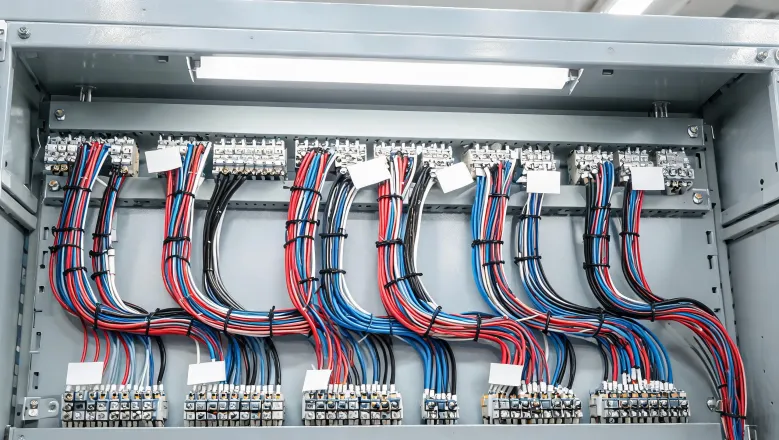
An OEM enclosure is built to your drawings. Cutouts, holes, gland plates, mounting studs, door hinges, cable tie mount placement—all of it is designed around your product. You own the design; the enclosure manufacturer executes it.
A private label enclosure, on the other hand, is usually a factory standard design with your name on the label. The manufacturer didn’t change the engineering. They changed the paint on the nameplate. That’s not inherently wrong, but it’s not OEM work.
In the box OEM world, the same distinction exists. A true box OEM will engineer the back panel so your Panduit cable tie mounts are in the right position before powder coating. A private label vendor will drill generic mounting rails and let you figure out cable management during assembly. The first approach often costs more in machine setup. The second approach costs more in assembly labor and field failures.
Which is cheaper? Depends on your volume and design stability. If your design changes often, a private label stock box is lower risk. If you’re building the same control panel month after month, the OEM design that puts cable tie mounts in the right place will pay for itself in labor savings.
Now the counterintuitive part: private label is not automatically cheaper for cable ties. I know a no-name tie can be $0.01 less per piece. But if your build needs a UL-recognized cable tie assembly, you’ll need to verify data sheets, maybe run a sample test, and keep evidence for your quality file. Those activities are not free. I’ve seen a $40 “savings” on cable ties cost $400 in engineering review and paperwork. That’s a TCO problem, not a unit price problem.
We almost learned that lesson the hard way in Q3 2024. We tested a private label adhesive mount that looked almost identical to our standard Panduit mount. Vibration test showed lift-off at 40% of the Panduit-rated load. The private label vendor’s spec sheet didn’t cover the failure mode. We were one production run away from using it. So glad we tested.
This is also why we supply enclosures and Panduit cable ties together: not because it’s always the cheapest route, but because it reduces handoffs. In a rush order, fewer handoffs means fewer things to go wrong.
Scenario 3: No Spec, No Audit — Compare Total Cost
Not every cable tie application is safety-critical. If you’re bundling wires inside a dry, non-UL-rated cabinet, and no customer spec names a brand, you have room to use a different product. I’m not going to tell you that you must pay the Panduit premium out of brand loyalty. But I will tell you to compare total cost, not unit price.
What counts as total cost? The time to install the tie, the reliability of the mount, the rejection rate, the cost of a service callback, and the effect of using a tie that isn’t rated for the temperature or environment. Add those up, and sometimes the private label product is a genuinely smart buy. Other times, it’s a false economy.
Here’s where I really want you to think about Panduit cable tie mounts. A cheap tie will still hold a bundle. A cheap mount is where shortcuts show up. If the adhesive backing starts releasing after a year of thermal cycling, the whole bundle drops into the bottom of the cabinet. That’s not a cable tie failure. It’s a mount failure. So if you’re going to experiment, start with ties and leave the mounts alone until you’ve tested them in your actual environment.
Speed changes the calculation too. Last quarter, a client needed an electrical cabinet kit in 48 hours. There was no time for a custom OEM enclosure or a private label program. We used a standard enclosure, genuine Panduit cable ties and mounts, and got it out the door. It wasn’t the lowest quote. It was the one that arrived. In hindsight, I would have preferred a better price. But a better “price” that misses the deadline has an infinite cost.
How to Tell Which Scenario You’re In
Use these three questions:
- Is a Panduit cable tie or cable tie mount named in your spec, BOM, drawing, or audit document? If yes, Scenario 1. Stop here and use the exact part number. Your only job is to verify that the parts you receive are authentic and traceable.
- Are you selling the completed enclosure under your own brand and controlling the internal layout? If yes, Scenario 2. Decide whether you need true box OEM engineering or whether a private label stock enclosure is good enough. Then specify the cable management system the same way you specify the enclosure—don’t leave it as an afterthought.
- Are you buying for internal use with no external spec, no certification requirement, and no safety-critical loading? If yes, Scenario 3. Run a total cost comparison. Test the actual product, especially mounts, before you standardize on it.
A lot of buyers want a universal rule. There isn’t one. But the scenario test above will get you closer to the right answer than a chart that says “Panduit = expensive, private label = cheap.”
Bottom Line: Panduit Cable Tie Sourcing Is a Total-Cost Decision
Total cost = unit price + lead time + compliance verification + installation/rework + warranty risk.
The question isn’t “Panduit cable tie vs private label.” The question is what your application needs, and how much a failure will cost you.
If you’re in a compliance-driven scenario, use Panduit and move on. If you’re doing OEM work, design the cable tie mounts into your enclosure spec. If you’re in a non-critical scenario, compare total cost honestly.
One last note: I can only speak to the mid-size B2B OEM and panel builder world. If you’re a multinational with a global supply agreement, your process is different. And pricing and lead times in this market change fast—what I’ve described reflects Q1 2025 conditions. Verify current availability before you commit to a plan.
Now, which scenario are you in?