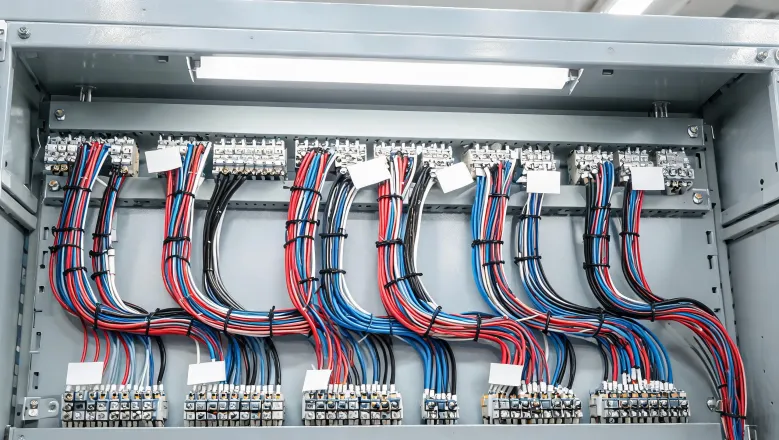
Here's the short version: if you're sourcing Panduit cable ties and electrical enclosures by comparing unit prices, you're overpaying. I know how that sounds—I started my career in procurement doing exactly that. But over the past six years of tracking every purchase order in our cost system, I've found the lowest quote costs us more in about 60% of cases. Not always. Not even most of the time in some categories. But often enough that we changed how we buy.
In Q4 2023, I audited $210,000 in enclosure and cable management purchases. The visible product cost was $210,000. The hidden cost—expedited freight, rework, engineering time, and replacement parts—added another $38,000. That's an 18% surcharge that never showed up on the invoice.
I'm a procurement manager at a 60-person electrical equipment distributor. I've managed an annual budget of about $350,000 for enclosures, boxes, and cable management since 2019, negotiated with more than 40 suppliers, and documented every order in our system. I'm not a certified UL inspector or an engineer. I'm the person who signs the POs and then hears about it when something doesn't fit.
Where the 'Cheap' Quote Gets Expensive
Probably the first surprise: cheap parts usually work. The boxes arrive, the Panduit cable ties look fine, the mounts seem reasonably made. The problem is rarely visible on day one. It shows up at installation or during a customer audit.
A vendor in Texas quoted us 9% below our incumbent for a batch of wall-mount boxes. On paper, it was a no-brainer. Surface illusion? (surprise, surprise) The reality was different. The boxes had no UL markings for the application, no technical docs for the cut-outs, and the customer service rep took five days to answer one question about conduit knock-outs. We paid $1,200 for an outside inspection, lost two weeks on the project, and ended up replacing half the batch. That 9% savings turned into a 14% cost overrun.
Here's something vendors won't tell you: the first quote is not the final price for new or low-volume orders. If your specs are loose, there are extras waiting in the wings—tooling charges, partial-batch fees, custom labeling, pallet packaging, documentation fees. Not always, but often.
Compliance: The Part That Makes Price Irrelevant
This is where the comparison stops being about money and starts being about risk.
As of January 2025, UL 508A remains the reference standard for industrial control panels in North America. The standard covers the whole assembly, not just the enclosure. That means the wiring, the terminal blocks, the cable ties, the mounts, the whole arrangement—it all has to be traceable and rated for the panel's environment.
People assume cable ties are a commodity. I made that mistake too. A Panduit cable tie has published tensile strength, flammability rating, temperature range, and—depending on the part—UL or CSA recognition. That documentation is not a marketing tool. It's evidence. Without it, a third-party inspector can flag the panel, and then the customer asks us to redo the work.
Let me be specific: cable tie mounts. Small part, tiny price. But in a hot enclosure, a mount with the wrong adhesive or a non-rated base material can fail. When a bundle of wires breaks loose and settles against a live terminal, it doesn't matter that we saved $0.02 per mount. That's a liability problem.
What most people don't realize is that installed cost is the real number. For a typical enclosure with 250 tie wraps, an extra 15 seconds of installation time per tie is over an hour of labor. A slightly higher-priced mount that works cleanly with a Panduit tensioning tool can actually reduce labor cost. The unit price alone can't tell you that.
What Changed My Mind About Vendors
It took me three years and about 150 orders to understand that supplier capability matters less than supplier willingness to document compliance.
That's a weird thing to say, because capability sounds like the substantive factor. But in practice, every vendor has a warehouse and a catalog. What separates the good ones is whether they'll commit to something in writing. Will they list the standards? Will they confirm the cable tie mounts are rated for the max internal temperature? Will they answer that question before the order, not three weeks after?
After five years of managing this category, I've come to believe that "best vendor" is context-dependent. For a one-off standard box, the lowest bid might be fine. But when a customer attaches a spec that references UL/NEC, the vendor who sells compliance and engineering support wins. It's less exotic than it sounds.
How I Evaluate an Enclosure Supplier Now
I didn't rebuild our whole process. I added four questions to the RFQ:
- Send the compliance documentation before the PO. If the supplier can't send UL references, cut sheets, or material test data before payment, that's a red flag.
- What happens if a batch arrives with bad welds or scratched finishes? A clear, written RMA process is more revealing than a low price.
- Do you support OEM/private label? If we're buying boxes to resell under our name, re-labeling costs add up fast. A supplier that handles that upstream is worth something.
- Can you bundle the enclosure with Panduit cable ties and mounts? Not because one-stop shopping is magic, but because it reduces purchase orders and gives us a single source of accountability when something gets flagged in an inspection.
This last one changed our spend more than any negotiation tactic. By consolidating our box and cable management orders, we didn't necessarily get the lowest unit price—but we did cut freight cost, admin hours, and inspection-related finger-pointing.
When a Price-First Approach Actually Works
Now the honest caveat. I don't want to pretend every budget quote is a trap. That would be wrong and, frankly, lazy.
Price-first makes sense when:
- You have a qualified engineer in-house who can evaluate non-certified components and accept the equivalency risk.
- The application is not under UL/NEC jurisdiction, and nothing in the customer contract requires a certified assembly.
- The part is genuinely interchangeable—something simple like a standard junction box from a supplier you've used for years and never had a problem with.
In those cases, go ahead and compare unit prices. That's what they're for.
But for anything that ends up in a control panel or gets shipped to a customer with a specification sheet attached, the unit price is the last number you should look at. That sounds counterintuitive, especially when budgets are tight. It took me six years of spreadsheets to believe it.
The Bottom Line
The lowest quote is not the lowest total cost. The invoice is the beginning of the cost, not the end.
I'd rather pay $0.02 more for a Panduit cable tie mount and get the documentation on the table before the inspection. I'd rather buy enclosures from a supplier who answers spec questions in days, not weeks. And I'd rather consolidate orders with one supplier, even if a spreadsheet says another vendor's line-item total is a little lower.
Verify current compliance requirements via UL's Product iQ database or your local authority having jurisdiction. Standards change; don't base a 2025 order on a 2019 datasheet. And if you're the person signing the POs, keep your own trail. Eventually, the data will tell the truth about which supplier was actually cheapest.