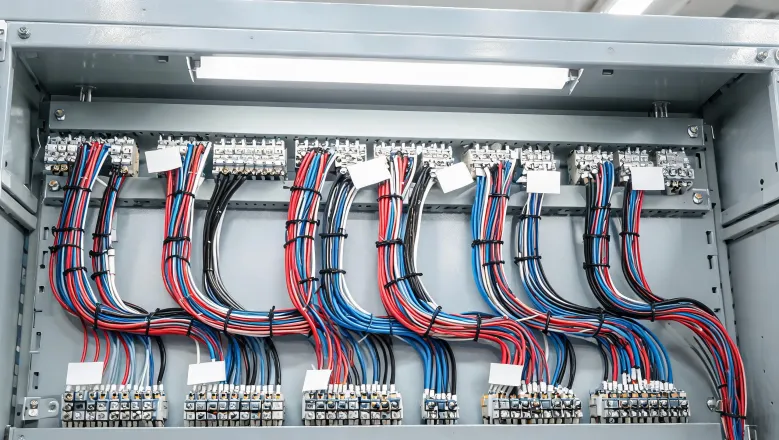
The 4:10 p.m. Thursday Call
The email arrived at 4:10 on a Thursday. A panel builder needed 5,000 Panduit cable ties, 800 panduit cable tie mounts, and 12 bulk electrical enclosures on a job site by Monday morning. Normal lead time on those cabinets was three weeks — actually, closer to four once you count first-article approval.
He was calm about it, which told me this wasn't his first time. He'd already decided the problem was on our end — stock, production schedule, freight. That's the assumption almost everyone makes. When an electrical enclosure order goes sideways, the reflex is to blame the supply chain.
I coordinate expedited orders at an electrical supply company. I've handled 400+ rush requests in nine years, including same-day turnarounds for OEM panel shops and one memorable Friday that ended with a semi truck and a very unhappy dispatcher. Here's what that experience taught me: the phone call is almost never about speed.
It's about a decision somebody made — or didn't make — three to six weeks earlier.
Rush Orders Are a Symptom, Not a Category
Of the 63 emergency requests we processed last quarter, 44 traced back to something that could have been caught at the quote stage. Not the factory floor. Not the freight broker. The quote.
Everything I read about sourcing before I started doing it said the same thing: build a vendor list, get three quotes, negotiate hard. In practice, for this specific category — electrical enclosures and cable management — the bottleneck is rarely vendor selection. It's that the request that went out to bid was underspecified, and nobody noticed until production.
Three causes account for most of it.
Cause #1: "Panduit Cable Tie" Is Not a Specification
A purchase order that reads "Panduit cable tie, 8 inch, qty 5,000" looks complete. It isn't, and the gap is where emergencies live.
What's missing is usually one of these:
- Cross-section and tensile rating. A miniature tie and a standard tie in the same length family can differ by 30+ pounds of loop tensile strength. Whoever wrote the PO may have been picturing the light one while the harness they're bundling needs the heavy one.
- Material. Standard nylon 6.6, heat-stabilized, UV-resistant black, or stainless steel (Pan-Steel). Same footprint on the drawing, completely different service environment.
- Listing. UL 62275 is the reference standard for cable ties used in electrical installations. If your spec sheet doesn't name a file number, you're buying on trust — and trust doesn't survive an inspector's visit.
The mounts are worse, honestly. Adhesive-backed mounts and screw-mounted bases are not interchangeable, and the difference doesn't surface until installation day. UL 1565 (Positioning Devices) is the reference category for cable tie mounts and clamps in the U.S., though how any specific mount is classified depends on its construction. The adhesive variants carry their own temperature and surface-preparation limits that have nothing to do with the enclosure rating.
I assumed "adhesive mount" meant roughly the same thing across the ABM series. Didn't verify. Turned out the temperature ceiling varied enough between configurations that a cabinet interior running warm on a summer afternoon sat right at the edge of the rating. We replaced 6,000 pieces on our own dime. That was March 2024, and it's why I ask for the datasheet before I ask for the quantity.
Cause #2: OEM vs Private Label Decided Too Late
This one is more expensive than the first, because it gets decided at the quote stage whether you realize it or not.
In an electrical cabinet OEM arrangement, the enclosure is built to your drawing — your cutouts, your gland plate layout, your branding, sometimes your tooling. In a private label arrangement, you buy the supplier's existing enclosure platform and put your name on it.
Both are legitimate. Plenty of buyers end up in private label and are happy about it, because it skips tooling cost and shortens the approval cycle. The problem is what happens when someone quotes it as one and expects the other.
To be fair, the line gets blurry at mid-volume — a lot of suppliers will build a semi-custom platform and still call it private label, which is fine. That said, when the paperwork says OEM and the drawing package never left the sales folder, you find out at first-article inspection, not before.
Cause #3: Compliance Evidence Requested After the PO
UL file numbers. NEMA 250 type ratings — Type 1, Type 12, Type 4/4X, Type 3R — and the fact that those types are not progressive upgrades of one another. IEC 60529 IP ratings. RoHS Directive 2011/65/EU. REACH. If your end customer is an OEM with a supplier quality team, they will ask for all of it, and they'll ask on the day they need it.
There's a second layer that catches people: you can't just assert compliance. Per FTC advertising guidance, claims like "UL listed" or "RoHS compliant" have to be truthful, non-deceptive, and substantiated with evidence before you publish them. That applies to the spec sheet you hand your customer, not just your website.
So sequence matters. If the certificate request lands after the PO is released, you're now waiting on a document from a supplier who is already building your order — and the customer won't accept the build without it.
What the Delay Actually Costs
Let's put numbers on it, because "specify more carefully" sounds like nagging until you see the invoice.
In 2022, a customer needed 14 enclosures for a controls package with a penalty clause tied to the install date. We paid $800 in expedited freight on top of a $9,400 order. Ugly, but the alternative was a five-figure penalty. The client got their boxes. That one worked out.
The ones that don't work out look like this: I still kick myself for a 2023 order where we ate $2,100 in air freight because nobody checked that the mounting-hole pattern on the customer's drawing didn't match the enclosure series we'd quoted. The hardware didn't line up in the field. Two electricians spent a full day drilling. The enclosure was fine. The drawing was fine. The assumption was not.
Underneath the hard costs — expedited freight, rework labor, penalty clauses — there's a softer one. Panel shops remember which suppliers made their emergency worse. That memory outlasts the invoice.
What Actually Fixes This
Not a process overhaul. A twenty-minute review before the RFQ goes out.
Five minutes of verification beats five days of correction. Every time I've skipped it, I've paid for it in freight, labor, or both.
The short version of the checklist we run:
- Tie spec: length, cross-section, tensile, material, color, listing reference.
- Mount spec: adhesive vs. mechanical, screw size, temperature and surface limits.
- Enclosure spec: NEMA type or IP rating, dimensions, material, finish.
- OEM or private label — named explicitly, with the drawing package attached.
- Compliance documents requested and received before the PO, not after.
That's it. The rest is sourcing.
Which is where I'll be honest about my own bias: I work for a company that stocks both halves of this problem — bulk electrical enclosures and cable management — so a checklist that gets the spec right the first time is good for us too. Fewer rush orders isn't fewer orders. It's the same orders, planned.
If you're running an RFQ right now and something on that list is blank, that's your emergency. It just hasn't reached the phone stage yet.