-
What's the actual difference between Panduit cable tie types?
-
Do I actually need panduit cable tie mounts for every bundle?
-
What should I look for in an electrical enclosure distributor, other than price?
-
What should I verify before ordering electrical enclosure private label boxes?
-
Can I substitute another cable tie brand when the spec calls out Panduit cable tie?
-
How many Panduit cable ties and mounts should I actually order?
-
Should I order Panduit cable ties and electrical enclosures from the same distributor?
I manage purchasing for a control panel shop with about 65 employees. That makes me the person who orders the enclosures, the Panduit cable ties, the mounts, and everything else that goes into a panel before it ships. It's roughly $450,000 a year in electrical supplies — maybe $430,000 depending on the quarter — across about a dozen vendor accounts.
This article is the FAQ I wish I had when I took over the role in 2020. Back then, I thought buying cable ties was a 60-second job. Five years and a few expensive surprises later, I know better. The problems we ran into weren't usually the products; they were the details I didn't verify before ordering. These are the questions I ask myself now.
What's the actual difference between Panduit cable tie types?
It's tempting to think a cable tie is a cable tie. That's how I treated them at first, and then I got photos of cracked ties on a customer's outdoor equipment after two winters. The obvious difference is color. The important differences are material, tensile strength, temperature rating, and UV or chemical resistance.
Standard indoor nylon 6.6 ties handle most of the control panels we build. Black nylon with UV stabilization is a safer choice for outdoor exposure or direct sun. Stainless steel starts to make sense in washdown, chemical, and high-heat environments. According to Panduit's published technical data, many of their standard nylon 6.6 ties are rated for continuous use in the -40°C to 85°C range, but I don't trust my memory on that one. A datasheet check takes ten minutes. Explaining a field failure to a customer takes much longer.
Do I actually need panduit cable tie mounts for every bundle?
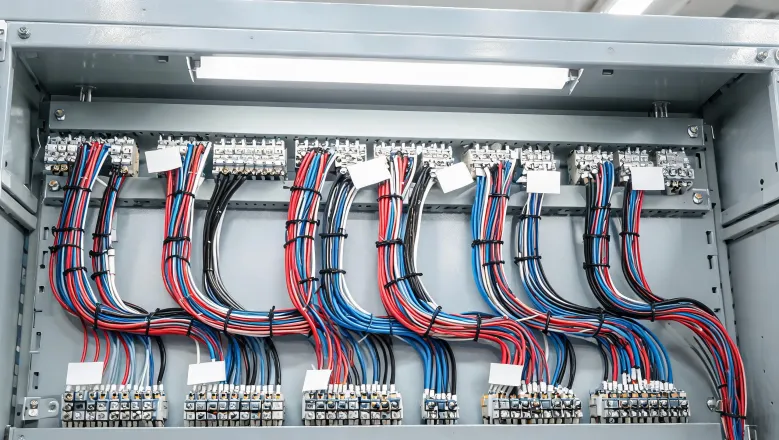
No. If a bundle is lying in a raceway or running through a cable tray where nothing will move it, a tie alone is fine. But a cable tie is a fastening device, not a mounting device. When you need to secure bundles to the back panel of an enclosure, a mount is the engineered way to do it.
Adhesive-backed mounts are common in indoor panels, and they work when the surface is clean and the temperature is within the mount's rating. For vibration, high heat, or an enclosure door that gets opened regularly, screw-mounted options have saved us from callbacks. Why does this detail matter? Because Panduit cable tie mounts are rated for a maximum tie width, and it's easy to overlook that spec. We once ordered mounts that were too narrow for the ties we already had in stock. Same brand, same catalog family — I just didn't check the width column. The restocking fee and the delay weren't huge, but the whole thing would have been avoided with one comparison.
What should I look for in an electrical enclosure distributor, other than price?
When buyers ask for an electrical enclosure distributor buying guide, they usually expect a spreadsheet of price comparisons. Price matters. For standard enclosures, though, the price difference between reputable distributors is rarely the thing that hurts you. Reliability is.
- Paperwork quality. A missing certificate of conformance can hold up a shipment to your customer. A sloppy invoice can get rejected by your own finance team. Both take hours to fix.
- Actual stock versus promises. Some distributors say in stock when they mean we can order it. Those are not the same thing. We now ask for the quantity they physically have before we commit.
- Application knowledge. If your contact cannot tell you why one enclosure listing matters for a given environment, you will be the one explaining that to an inspector later.
During our 2024 vendor consolidation project, we ranked five distributors on these items before awarding volume. The distributor with the lowest price on enclosures finished near the bottom. It wasn't that the product was bad. Every order just required extra phone calls to clean up details.
What should I verify before ordering electrical enclosure private label boxes?
Private label can be a legitimate way to get standard enclosures without paying a brand premium. But private label is not a product spec. It tells you who put the label on, not who engineered the box.
We have bought private-label enclosures successfully. The orders that worked were the ones where we asked these four questions first:
- Who is the manufacturer of record?
- Can you show me the UL or other certification listing that applies to this exact model?
- Will you provide dimensional drawings and submittal documents I can pass to my customer?
- How are warranty claims handled if the finish or gasketing fails in year two?
The last question is the one most buyers forget. The cheapest source in the world is expensive if they disappear when a problem shows up. In 2021, we nearly switched a large order to a private-label supplier that quoted about 20% less. The sample looked fine, but they could not provide certification documents under their own label. We passed. I can't prove we dodged a bullet, but I know the paperwork gap would have become our problem during an audit.
Can I substitute another cable tie brand when the spec calls out Panduit cable tie?
Sometimes. The phrase to look for in the spec is or approved equal. That phrase creates a path for substitution. It also creates the burden: somebody has to approve the equality, and that approval is usually based on data, not on how similar the product looks.
In our shop, engineering requires the substitute's data sheet showing material, tensile strength, temperature rating, and flammability classification. If the numbers match, we can proceed. If nobody verifies, you can end up doing cable management twice. On one project, an unapproved substitute was installed in 14 cabinets before someone spotted it. One electrician spent a full shift cutting out and replacing ties. The price difference between the approved ties and the substitutes was maybe $40. The labor cost was around $800. Nothing about that saves money.
How many Panduit cable ties and mounts should I actually order?
If you're building from drawings, count the tie points per panel and add 10 percent for field changes and service loops. If you're stocking for ongoing production, look at the last three months of real usage and set your reorder point around a six-to-eight-week supply. What doesn't work is ordering a lifetime supply because the per-unit price drops at a higher quantity.
I almost approved a volume order once because the unit cost dropped by 18%. What stopped me was a simple calculation: we would have sat on that inventory for nearly two years, and we don't have the stockroom space. I want to say the order was for 500,000 ties, but the precise number doesn't matter. What matters is that a discount only becomes savings if you consume what you buy. The same reasoning applies to Panduit cable tie mounts. We keep one or two standard types on the shelf and order project-specific variants against the drawing schedule.
Should I order Panduit cable ties and electrical enclosures from the same distributor?
If you'd asked me in 2020, I'd have said no. Buy enclosures from enclosure people and cable ties from people who sell cable ties. But that advice misses the real cost of every supplier relationship. Every purchase order costs something before the product even ships: time to create the PO, receive the shipment, and match the invoice. Our accounting team estimated that internal cost at roughly $45 per PO. Maybe it was $38; I'm mixing it up with the freight average. Whatever the exact number, extra orders are not free.
We now order many standard enclosures and our Panduit cable tie line items on the same order with a distributor that is strong in both. The benefit isn't a better price on either line. It's fewer POs, fewer freight receipts, and fewer small shipments to track. One-stop sourcing is not an excuse to overlook the checks above. You still verify specs, lead times, and paperwork. But when the answers are right, combining orders is the easiest way to cut the administrative cost out of your buying.