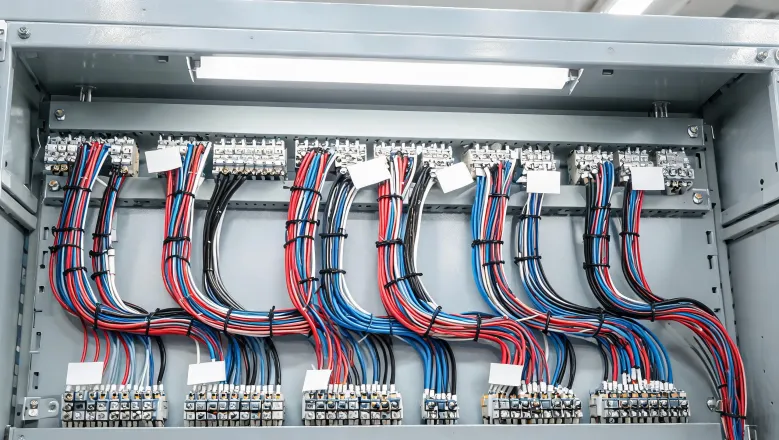
I once “saved” $180 on an order of electrical enclosures and cable ties. By the time we returned the non-compliant enclosures and paid for an expedited replacement shipment, that $180 “saving” had become roughly $900 of actual cost. None of it showed up on a purchase order line.
That was in 2023, and it changed how I buy for our plant. I'm the purchasing administrator at a 280-person custom equipment manufacturer. Since 2020 I've handled MRO and electrical purchasing: enclosures, junction boxes, Panduit cable ties, cable tie mounts, labeling tools—about 60–80 POs per year across eight or more vendors. I don't design panels and I don't sign off on electrical drawings. But I'm the one who has to explain it when the wrong component stops a build.
So I'll state my position directly: unit price is the least reliable number on a supplier quote. Unit price tells you what it costs to get a product onto a truck. It doesn't tell you what it costs to get it installed, inspected, and running. If you compare only that number, you're not comparing suppliers—you're just guessing.
Argument one: unit price hides spec risk
The 2023 order that taught me this was partly an enclosure problem. We needed wall-mount electrical cabinets for a machine retrofit. The low-priced supplier quoted about 18% below the nearest comparable offer and described the box as “NEMA 12 equivalent.” When our engineer asked for enclosure compliance requirements—labeling, rating, traceability—the salesperson went quiet.
That's not how enclosure ratings work. NEMA 12 has a definition in NEMA 250, and it means indoor protection against circulating dust, lint, fibers, and dripping water. You don't get to call a box NEMA 12 just because the sheet metal looks similar. If the manufacturer can't provide documentation, the rating doesn't exist for your purchasing file.
Then came the sentence I hear too often in this industry: “It's basically the same. Nobody will check.” That ended the conversation for me. In our world, somebody checks—maybe our own quality team, maybe the customer, maybe an inspector. When documentation is missing, the panel doesn't ship.
We returned the enclosures, paid return freight, and reordered from an enclosure distributor who could explain electrical cabinet specifications before we asked. The second order cost more than the first quote. The total bill for choosing the low bid was higher than the low bid's advantage—plus we lost a week of schedule.
It's easy to think that lesson applies only to big-ticket equipment. It applies to cable ties with the same force. A Panduit cable tie may cost pennies, but it has a real specification: material, tensile rating, flammability class, temperature range, and manufacturer traceability. Most buyers compare per-100 prices and miss the specification risk hiding in those details. If a cheap tie fails in a hot cabinet or on an outdoor cable tray, the cost is not another bag of ties. The cost is a service call, a rework crew, and downtime.
For anyone who wants to dig into the technical side, cable ties used in electrical installations are evaluated to UL 62275. The standard covers marking, mechanical performance, and environmental suitability. If a distributor can't produce the manufacturer's data sheet, you aren't buying a spec. You're buying a photograph.
The same reasoning applies to panduit cable tie mounts. Adhesive, screw-mount, push-mount—they are not interchangeable guesses. Put an adhesive mount on a hot or vibrating surface and you'll learn the difference after the wire bundle moves. That's not a component failure. That's a specification failure, and specification failures come out of your budget, not the vendor's.
Argument two: vendor capability shows up in your accounting office
The next part of the total cost story doesn't happen on the plant floor. It happens in accounting. Vendor capabilities show up in the quality of their paperwork.
In our 2024 vendor consolidation project, we cut from eight vendors to four. That removed a lot of duplicate freight and administrative work. But the vendor with the sharpest unit prices had a problem: their invoices weren't itemized. Line items didn't reference our POs. Finance rejected $2,400 in charges because nobody could tell what we'd actually received. The material was fine. The purchasing process wasn't.
I now ask about invoicing before I ask about price. Will the invoice show model numbers? Will packing slips carry purchase order numbers? Does the supplier answer when accounting has a question? A vendor that can't manage paperwork will cost more than the price difference—usually in ways no one tracks.
Freight is the quiet cousin of bad paperwork. If enclosures come from one supplier and cable ties from another, you pay two freight bills, schedule two deliveries, and check two receipts. On smaller orders, freight can exceed the unit-price savings. One reason I consolidate with a capable supplier is to cut those fixed costs—not because buying from a single vendor is magically better.
Argument three: time is part of the price
Time is the cost people rarely put on the comparison. Every hour I spend chasing a wrong shipment, a missing data sheet, or a corrected invoice is an hour taken from something else.
Last year, a rush panel build stopped because the cable tie mounts from a discount supplier didn't match the enclosure surface. The replacement was supposed to be a screw-mount panduit cable tie mount, but the shipped item had a different mounting height. The technician opened the box, saw the mismatch, and we placed an expedited order. The freight was around $50. The lost scheduling window on a critical build was worth several times that.
Then there's the cost of technical conversations. If I call an enclosure distributor and ask whether a cabinet is suitable for a washdown area, “I think so” isn't an answer. I need someone who can pull the NEMA or IP rating, state the limits, and mention any extra requirements. One good conversation saves four emails and most of an afternoon.
“But I'm reviewed on unit price”—you can still track total cost
I can hear the objection coming: “Easy for you to argue. My boss reviews me on line-item price.” I get that. I report to finance too.
In my experience, the fix isn't to ignore unit price. It's to measure total cost with the same discipline. Once we started coding freight, rework, returns, and expedite costs back to the original PO, the numbers told a different story. The vendor with cheap prices didn't look cheap anymore. The one with better documentation, accurate invoices, and real technical support looked reasonable. Finance didn't argue with a report—they had just never seen the full picture before.
To be clear, I'm not saying every so-called premium line item is worth its premium. Sometimes an inexpensive component is perfectly adequate for low-risk, indoor, general-purpose use. The difference is deciding that on purpose, instead of assuming that cheap and adequate are the same thing.
The final number is the only number that matters
When I took over this purchasing role in 2020, I compared electrical suppliers the same way I compared office paper: lowest line item wins. Five years later, I still compare price. I just don't stop at price.
Now my questions are: Does the enclosure meet the actual electrical cabinet specifications? Is documentation available for enclosure compliance requirements? Are the Panduit cable ties and the panduit cable tie mounts exactly what the drawing calls out? How does the vendor handle an error? Will the invoice make accounting's life easier?
Unit price is the number you see first. Total cost is the number you live with at the end. When I look at a quote now, the only number that matters is the final one.