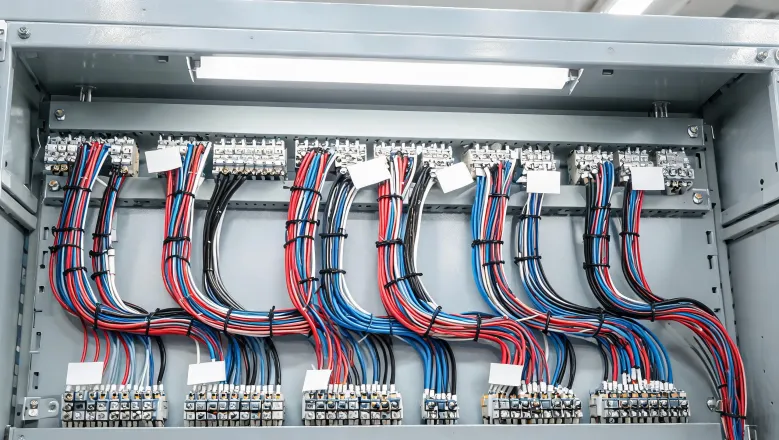
At 11:35 on a Tuesday in January 2024, our QC supervisor put a small black plastic cable tie mount on my desk. It was the kind that holds wire bundles cleanly inside an electrical enclosure. It looked harmless. She did not.
“This is what cost us two days,” she said.
Behind her sat a cart of finished enclosures from a 240-unit bulk enclosure order. Eight of the units had the same defect. The mount’s adhesive backing had lifted from the steel panel, leaving wire bundles loose. In two panels, the harness had sagged close to a live terminal. Nothing shorted, but everyone in the room understood how easily it could have.
If you buy for an electrical equipment company, you will eventually face a version of this story. I’m sharing mine because the failure wasn’t caused by a careless installer. It was caused by a purchasing decision I made to save about four cents per mount.
The cost-saving decision that made sense on paper
I’m not an engineer. I’m the office administrator for a 68-person electrical equipment manufacturer. I manage procurement and vendor relationships for roughly $850,000 in components every year. I report to operations and finance, which means I hear about the same problem from two sides: too much money spent on materials, and too much time spent fixing things that failed.
When I took over purchasing in 2021, one of my first rules was to challenge unnecessarily specific brand specs. There are plenty of cases where a branded product costs more just because of the name. That mindset saved us money on packaging, fasteners, and labels. It also made me overconfident.
Our standard for internal wire management was simple: use Panduit cable ties and Panduit cable tie mounts. It wasn’t just default spec. Many customer drawings named those products directly. In late 2023, a new private-label vendor approached us with a mount that looked almost identical to the Panduit cable tie mount we were buying. Same dimensions. Same satin finish. The sample stuck to a scrap panel with no problem. The price was 28% lower.
On a bulk enclosure order, that price difference stopped being pennies. It became a real line-item savings. I did not send the sample to engineering. A tie mount seemed too simple to need review. That was my mistake.
The failure was not dramatic, and that made it worse
We assembled the enclosures in early January 2024. The new mounts looked fine during the first run. Then a final inspector opened a cabinet during a routine pre-shipment audit and noticed a wire bundle sitting lower than it should. She checked another unit. Same issue. By the end of the day, 19 of 240 enclosures had at least one loose mount.
Because this was a bulk enclosure order, the problem repeated across the whole production line. The mounts were not falling off the panel immediately. They were lifting slowly after hours of shop heat and light vibration. The wire ties themselves never broke. The anchor did.
We reworked all 19 units. The supplier offered a credit for the mounts, but not for labor. The total cost for rework, replacement materials, and the customer’s two-day audit came to about $9,400. The $2,000 we expected to save disappeared. Worse, the customer’s engineer kept asking why we substituted a specified part without telling anyone.
That conversation was the real cost. I could explain the logic, but I couldn’t defend the process. We changed a qualified component based on appearance and price. There was no engineering sign-off, no comparison of standards, no evidence that the replacement was an approved equal.
The side-by-side comparison that changed my mind
After the shipment finally went out, I put one of the rejected mounts next to a Panduit cable tie mount. Side by side, they looked like the same product. That was the point. The differences were not visible in the first five seconds. They were in the release liner, the adhesive behavior, and the material’s performance under heat. I am not a materials engineer, so I did not need to be. Our failure rate was the test.
I had been acting like all cable ties and cable tie mounts were interchangeable. That’s an older way of thinking, and it comes from a time when cable ties were mostly used to bundle wires in low-risk locations. Inside an electrical enclosure, the context is different. Vibration is normal. Heat is normal. An inspector may open the door at any moment and judge the quality of the whole cabinet by what is inside.
Today, the standard I ask about is UL 62275. It is one of the standards used for cable ties in electrical installations, and it covers more than cosmetic dimensions. It addresses flame propagation, temperature range, and mechanical performance. If a supplier cannot connect their product to that type of qualification, I no longer call it an equivalent. I call it an untested sample.
I checked the UL Online Certification Directory in December 2024 before writing this. Not every product sold as a cable tie or mount shows up with the same listings. That matters when you are building equipment that has to survive a customer audit.
Quality perception is part of the product
Why did such a small component cause such a large problem? Because an enclosure is judged by what is inside it. Tight terminals, clean wire routes, and properly anchored bundles create confidence. A loose cable tie mount does not look like a vendor issue. It looks like your workmanship has slipped.
I used to think quality perception arguments were too soft for procurement decisions. Now I have evidence. The customer approved the shipment after rework, but our sales rep spent weeks answering questions about a four-cent part. That is not a materials problem. That is a trust problem.
I’m not saying every product in an electrical cabinet must be priced at the top of the market. I’m saying visible integrity is worth protecting. If your company’s name goes on the outside, the inside should match the promise.
How we updated our enclosure specification guide
In April 2024, we finished a review that should have happened before the substitution. I went through our electrical enclosure catalog and flagged every model that included internal wire management as part of our standard build. Then I wrote a short enclosure specification guide for our purchasing and engineering teams.
The guide has one core rule: if a customer specifies Panduit cable ties or Panduit cable tie mounts, any change must be reviewed by engineering and logged as a deviation. If the customer allows substitutions, the vendor must provide data tied to a recognized standard. Samples alone are not enough.
The guide also gives our team permission to say no. When a supplier says a cheaper mount looks identical, we ask for the same evidence we would present to a customer reviewer. Most suppliers respond well. The ones who get defensive make the decision easier.
Our electrical enclosure catalog now includes the default accessory package for each enclosure model. That means every quote, every sales drawing, and every bulk enclosure order starts with a clear baseline. If we change something, the change is intentional and approved.
I can only speak to our context: B2B electrical equipment, customer inspections, and OEM specifications. If you are bundling low-voltage cables in a non-certified product where no one will ever see the inside, the math may be different. But if your customer will open the door, the calculation changes.
This lesson was not really about one brand. It was about the gap between visually equivalent and technically equivalent. The next product that goes through our approval process will have to prove itself. If it does, I’ll buy it. But it won’t get approved on a sample and a smile again.