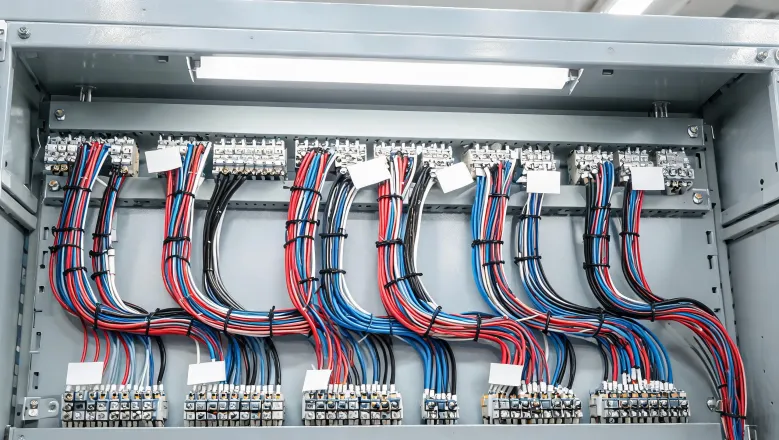
I'm the office administrator for a 58-person electrical panel company. I handle purchasing for enclosures, back panels, cable glands, and cable management supplies. In a typical year, I manage roughly $850,000 in material orders across eight to ten vendors, and I report to both operations and finance. When someone asks how to choose an electrical cabinet for wholesale, I don't start with unit price. I start by comparing two sourcing paths: split sourcing (enclosures from one supplier, Panduit cable tie mounts and cable management from another) and integrated sourcing (one electrical enclosure wholesale partner for the complete package).
Most buyers focus on the obvious number—price per cabinet—and completely miss what the quote doesn't include. The Panduit cable tie, the back panel, the mounting system, freight, and documentation are all part of the same purchase. After five years in purchasing, I've come to believe the better question is: which sourcing path gives you the lowest total cost, not which supplier shows the lowest line item?
Why Compare These Two Paths?
When I took over purchasing in 2020, we split almost every bulk enclosure order. Cabinets came from one distributor, Panduit cable ties from another, and mounting hardware from whoever had the best price that week. It looked normal. What I didn't see at first was the invisible cost: every mismatch, every missing part, and every extra invoice ended up on my desk. It took a few expensive orders for me to realize that split sourcing only wins when someone is tracking the total system, not just each line item.
From the outside, split sourcing seems like a smart way to keep suppliers honest. The reality is that nobody owns the entire specification. When mismatches appear, you become the go-between, and that cost rarely shows up on a quote.
1. Unit Price vs. The Complete BOM
When you order a bulk enclosure, you are not buying a box. You are buying the platform for your wiring system. That means back panels, gland plates, mounting hardware, and cable management. If you're using Panduit cable ties—and most panel builders I know do—the panduit cable tie mounts and the specific tie selection are as important as the cabinet itself.
A low price per cabinet can vanish when the accessory list is incomplete. In 2021, I approved an order for 40 cabinets because the quoted unit price was 11% lower than our normal supplier. The problem was that the supplier didn't supply panduit cable tie mounts or cable ties, and the freight quote had a $250 minimum that we couldn't avoid. After ordering cable management from a second distributor and paying rush delivery on a few small items, the total landed cost was actually higher than our regular integrated supplier quote. I still remember the finance director's face when I tried to explain the extra invoices.
2. Product Fit and Application Risk
The second area I compare is application fit. A cabinet is a system, not just sheet metal. If the supplier is quoting panduit cable tie mounts, they need to know whether those mounts will be screw-mounted to a back panel, adhesive-mounted to a painted surface, or clipped onto a DIN rail. Those are very different parts. In one project, we used an adhesive cable tie mount from a reputable brand, but the enclosure's internal surface was textured powder coat. The mounts started peeling off during installation. It wasn't a product failure; it was a selection mismatch.
An integrated wholesale supplier who sees these combinations daily can usually ask the right questions before you ask them. A generic enclosure salesperson may not think about cable tie environment or temperature rating. If the quote is just a parts list without an application note, treat that as a red flag. Not a deal-breaker by itself, but definitely a red flag.
3. Compliance and Documentation
When the end customer asks whether the cabinet can handle an industrial control panel, you need traceable facts. In the U.S., that often means UL 508A for industrial control panels, plus component markings for the parts inside. As of early 2025, that standard remains the baseline for most panel shops, but verify the exact scope with your certification body before making promises.
I want the supplier to confirm that the enclosure carries its required markings and that the cable-management parts—including the Panduit cable tie, if I'm using one—have data sheets for temperature, tensile strength, and flammability. It should not take three phone calls to get that documentation. A supplier who sends it with the quote is showing you their process. That has value, even if it doesn't show up on the invoice.
4. Procurement Overhead and Time Cost
This is the part I ignored at first. Every vendor relationship has hidden overhead: PO creation, invoice matching, delivery coordination, email threads. Time is part of total cost.
In our 2024 vendor consolidation project, we cut our active supplier list from nine to six and moved our standard cabinet and cable-management order to one electrical enclosure wholesale source. The time I spent on purchase orders for those materials dropped from roughly four hours a week to ninety minutes. That's a concrete saving. For someone in an administrative role, it makes a real difference.
When To Pick Integrated vs. Split Sourcing
For standard industrial cabinets and OEM runs, I usually recommend integrated sourcing. It shortens your feedback loop and gives you one company that can tell you yes, no, or a better spec. But split sourcing can still make sense if your project has very specialized enclosure requirements, if you already have a national contract with a preferred manufacturer, or if your engineering team wants total control over the approved BOM. Those situations are real.
My honest rule after five years is simple: choose the vendor that bids the full BOM and can support the application. If that turns out to be a split order because you have two excellent specialists, fine. Just make sure you're comparing total cost—including your own time—not just the unit price. That's how to choose an electrical cabinet for wholesale without inflating your future maintenance and overhead costs.