If you have ever quoted the same bulk electrical cabinet from an OEM factory and a private-label distributor, you know the awkward part: the boxes look similar while the paperwork doesn't. One document says 'per your drawing.' The other says 'standard product, private label.' That small difference decides how much risk ends up inside the order.
I am not an engineer, so I won't tell you which NEMA enclosure you need for a specific environment. From a purchasing perspective, what I can tell you after managing POs since 2022 is this: the label on the outside and the paperwork behind it are part of the product.
I am the office administrator for a 28-person electrical equipment supplier. I manage procurement for bulk enclosures, junction boxes, and wiring accessories, with roughly $950,000 in annual spend across 12 vendors. I report to operations and finance. In that role, I have signed off on private-label products that worked well and at least one that I would love to un-sign.
What OEM and private label mean in this comparison
In simple terms, OEM means the supplier builds the product to your specification. You send a drawing, a BOM, or a written description. The factory makes the bulk enclosure with your part number, approved cutouts, mounting arrangements, and sometimes with your name on the label. Private label means you choose a standard product from the factory's catalog, add your brand and product code, and resell it. It is faster, but the product doesn't change just because the label did.
The same logic shows up inside the box. At the component level, a private-label bill of material might describe 'cable ties equivalent to Panduit cable ties.' An OEM-driven BOM usually calls out the exact name: Panduit cable tie mounts, a specific length, material, and quantity. One is an actual specification. The other is an invitation to substitute.
Dimension 1: Documentation and listed performance
People assume products with recognized components cost more because of brand awareness. Actually, the manufacturer can charge a bit more because they maintain a testing and documentation file. According to UL Product iQ (productiq.ul.com), recognized components carry file numbers tied to a manufacturer and a product family. That file number is the first audit trail. It tells you what was tested and who is responsible if production changes.
When I evaluate a bulk enclosure supplier, I ask for the file number that covers the exact configuration I'm buying. If a supplier says 'we use the same factory as the big brand,' I ask them to prove that the specific model is listed, not just the factory. The same issue applies to Panduit cable tie mounts and accessory parts. Listed component or not? If no one can answer that with a document, the quote is only a photograph of intent.
This is where private-label enclosure buying gets dangerous. A standard catalog cabinet can be UL/CSA approved as sold. But the moment you add a knockout, enlarge a gland plate, or change the mounting panel, the tested configuration may no longer be the quoted configuration. That doesn't make the product unsafe automatically; it means you need an engineer to verify. I am not that engineer.
Dimension 2: Cost, minimums, and the invoice I don't want to explain later
Private-label buying often looks less expensive on the first invoice because there is no drawing review or custom tooling. Minimums are usually lower and lead times are shorter. OEM buying can involve samples, pre-production reviews, and higher order quantities, especially for custom electrical cabinets.
The counterintuitive part is that OEM can end up cheaper on total cost when you include startup and after-sale support. In 2023, I approved a private-label junction box order for a repeat customer because the quote was 21 percent below the OEM version. The product arrived and looked fine. The documentation did not. The supplier sent a generic compliance letter without a product-specific file number, the customer's inspector rejected the batch until the record was corrected, and we paid freight and labor to work around a cabinet that otherwise performed as expected.
That mistake cost more than the original OEM price difference. It also gave finance a reason to question my next sourcing decision.
Dimension 3: How the inside of the cabinet protects your reputation
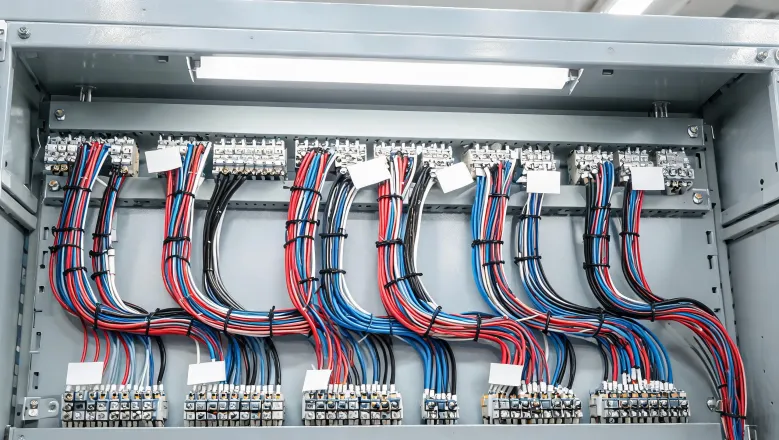
I used to treat cable ties and mounts as minor components. Then in 2024 a field technician sent me a photo from a private-label cabinet we sold. The paint was good, the door seal was good, and the wiring inside looked like it had been installed in a hurry. The customer's first impression was not about the enclosure rating. It was 'who built this panel?' The small details had become the brand.
That is why I now specify Panduit cable ties and Panduit cable tie mounts on most bulk electrical cabinet builds. Not because the cheapest tie can't hold a wire bundle in normal conditions—it can. From a buyer's seat, the reason is accountability. Panduit publishes datasheets and support documents, so the material, tensile rating, and temperature limit are traceable. If a problem shows up, I can find the exact spec, confirm it was the right part, and replace it consistently.
Quality perception is not vanity. Your customer opens that cabinet and makes a judgment before they ever power it on. If the inside looks accidental, they assume the engineering was accidental too. A documented cable management layout is one of the easiest ways to show that someone checked.
How I decide between OEM and private label now
If you are buying standard products and reselling them unchanged, private label can work. Verify the certification covers the exact product, lock the spec, and require written notice before substitution. If you are selling a bulk electrical cabinet that is part of your customer's machine or carries your company name as a quality promise, I lean OEM. You control the drawing and you control the approved component list.
There is also a middle path that I use more often now. Take a standard private-label enclosure, then ask the supplier to quote it as an OEM line item with a fixed drawing, fixed approved parts, and submittal documents. In that same BOM, specify Panduit cable tie mounts and Panduit cable ties by part number. This gives you the speed of a catalog product and the control of an OEM program.
Box OEM vs private label is not a status decision. It is a risk decision, and the right answer depends on who has to defend the product when something goes wrong. In my experience, buying quality on the inside is always cheaper than apologizing for the outside later.