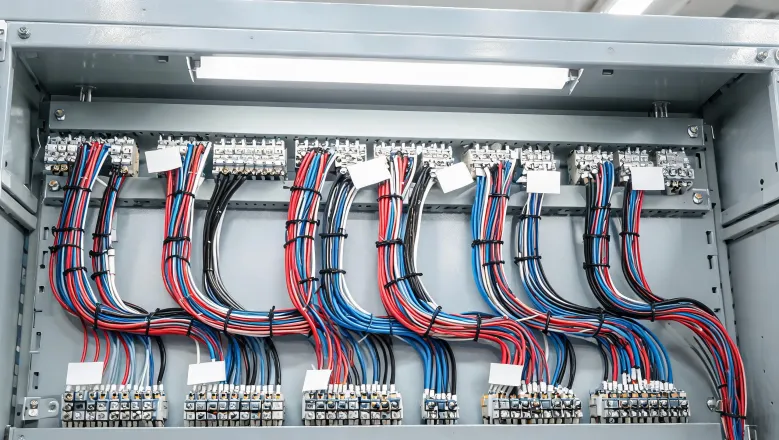
-
How do I choose a Panduit cable tie?
-
Will a cheap generic cable tie work instead of a Panduit cable tie?
-
What does a bulk box actually buy you?
-
Panduit cable tie mounts—do I really need them?
-
What are the most important electrical enclosure specifications I need to check?
-
How do I evaluate enclosure manufacturers before committing?
-
Do you take small orders seriously?
-
What's the mistake nobody asks about until it costs money?
I've handled B2B electrical enclosure and cable management orders for 7 years. I have personally made—and documented—11 genuine screwups, totaling roughly $22,000 in wasted budget. (I keep a spreadsheet. It makes my team laugh, and it keeps them from repeating my dumbest moves.)
This FAQ is the sort of thing I wish I'd had before I bought my first bulk box of Panduit cable ties and before I approved my first enclosure order. You don't need to learn the same way.
How do I choose a Panduit cable tie?
Let's start with the question we get most. There's no universal answer for every install, but there is one universal mistake: buying on length and price without checking material and environment. A standard Panduit cable tie is nylon 6.6 for a reason—it's resistant, affordable, and predictable. But 'nylon 6.6' can mean different things in UV, high heat, or chemical washdown areas.
Most buyers focus on the tensile strength and ignore the temperature rating and flammability classification. You can make that mistake once. (I did. I approved a big order of white standard ties for an outdoor installation because the price was impressive. They turned to chalk under UV within one summer. Ugh.)
If the application is outdoors, look for black UV-stabilized ties. If it's inside a hot industrial cabinet, check the continuous temperature rating and the UL 94 flammability class. And if it's a spec'd job, check the datasheet for the exact product. 'Panduit' is a starting point, not the whole spec.
Will a cheap generic cable tie work instead of a Panduit cable tie?
Sometimes yes. But 'sometimes' is doing a lot of work.
If the job only requires tying a bundle of cables in a dry office, a generic zip tie probably works. If the job references a brand, a drawing, a UL file, or a customer-approved product, a generic substitute can create a compliance problem. I once helped a customer with a panel that a third-party inspector flagged because the spec said Panduit and the install used a no-name tie. The fix was not fun.
I'm not saying generic is evil. I'm saying the answer is not 'all cable ties are the same.' Trust me on this one: the datasheet should match the spec, and you should be able to trace what you installed. If the job says Panduit, buy through authorized distribution.
What does a bulk box actually buy you?
A bulk box means loose cable ties in a larger quantity—usually 1,000 or more—instead of smaller 100-piece packs. That's the economical way for installers and maintenance crews running through hundreds a day. The downside is that you need to keep those ties sorted by type, size, and material, because once they're out of the box, they all look the same.
I learned that after ordering a bulk box of a specific tie that was too long for the application. I saved maybe $40 on per-unit cost. We then spent three days cutting tails and trying to make them work in tight spaces. So much for the savings. The budget choice was, honestly, not a choice. That's when I updated the checklist (note to self: never decide cable ties by price per thousand alone).
Bulk box protocol: write the part number on the box and don't mix leftovers from different orders. This sounds overly careful until someone installs 500 of the wrong tie.
Panduit cable tie mounts—do I really need them?
You can zip tie to a frame if the frame has a hole, a slot, or a proper edge. But if you're fastening around a sharp corner or over a metal edge, you should be thinking about a mount.
Here's what nobody tells first-time buyers: the mount is what carries the load, not the tie. The tie holds the bundle; the mount holds the tie. An adhesive-backed mount can work on clean, smooth surfaces indoors. For vibration, high heat, or anything heavier than a handful of small cables, use a screw-mount base. Metal mounting bases make sense when the environment gets hot or when you need grounding.
The question everyone asks is 'which tie is strongest?' The better question is 'how is this bundle going to be held in place in this exact environment?' That question would have saved me from a sagging cable run I still get embarrassed about.
What are the most important electrical enclosure specifications I need to check?
The enclosure type, hands down. Size is easy to see. Type is what keeps you out of trouble.
A NEMA 1 or UL Type 1 box is basic indoor—no gasket, no weather protection. NEMA 12 is for indoor dust and dripping. NEMA 3R handles some outdoor rain and sleet. NEMA 4 is for outdoor and hose-down. NEMA 4X adds corrosion resistance and washdown capability. These are not arbitrary letters; they map to test conditions and intended environments.
It's tempting to simplify this into 'just get the highest IP rating.' But IP and NEMA ratings do not map one-to-one. If you're buying from overseas, ask for the UL Type / NEMA correspondence and the independent test report. I don't care how good the photo looks in the listing. The label on the box is what an inspector will read.
Reference: NEMA 250 defines enclosure type designations. UL 50 and UL 50E cover enclosure safety for North American applications. Always verify the exact Type rating on the nameplate.
How do I evaluate enclosure manufacturers before committing?
Ask for documentation before you ask for the price. That may sound backwards, but it saves everyone a lot of pain.
- Ask which standard the enclosure is built to (UL 50, UL 50E, NEMA 250, or another national standard).
- Ask which deviations and options are included in the quote—not just 'complies,' but what that actually means for your order.
- Ask for drawings, material thickness, gasket type, finish thickness, and inspection reports.
- Ask how they handle small orders. A manufacturer that answers technical questions well for a small order is worth keeping.
OEM and private label support matters, too. Maybe you're buying enclosures now, but the future is a private label product. It's a lot easier to set up that relationship with someone who's been straight with you from order one.
The 'always get three quotes' advice is fine, but it ignores a key thing: you're also getting three levels of documentation and three different interpretations of your spec. The cheapest quote only counts if it actually includes the same scope.
Do you take small orders seriously?
Yes. That's not a marketing line. Some of our best long-term customers started with a handful of enclosures and a box of cable ties. Small orders are how serious buyers test a supplier. I don't act annoyed by a trial order, because today's $200 order can be next year's $20,000 order.
Here's what you should expect from a good supplier, regardless of order size: a direct answer about lead time, a clear quote that lists what's included, and honest advice when the cheapest option isn't the right option. If a supplier treats you well before you've proven your spend, keep them. If they need a promise of big volume before they'll give you basic information, that tells you what the relationship will be like later.
Now for the part I can't promise: I can't promise 'lowest price.' Anyone can say that. But I can promise that a small order won't get a second-class response.
What's the mistake nobody asks about until it costs money?
Buying to the wrong specification—and I don't mean the part number. I mean the tolerance, the environment, and the certification frame.
For cable ties, people ignore the difference between indoor and outdoor material. For enclosures, people ignore the certification frame: a UL Type rating belongs to the enclosure as produced by a certified manufacturer, not to a similar-looking box without the same certification paperwork. If the enclosure needs a listed label, the manufacturer must be able to provide traceability to that label. You can't just buy an off-the-shelf box, paint a logo on it, and expect an inspector to accept it.
In my first year (2018), I accepted a low quote that looked equivalent in size and slightly different in every important internal detail. Net result: a $3,462 order that needed $1,250 in modifications, plus a week of schedule damage that my customer will never let me forget. So if there is one thing to take from this: ask what's included, ask for the exact spec, and get it in writing. The cost of a straight answer is much lower than the cost of learning it the way I did.