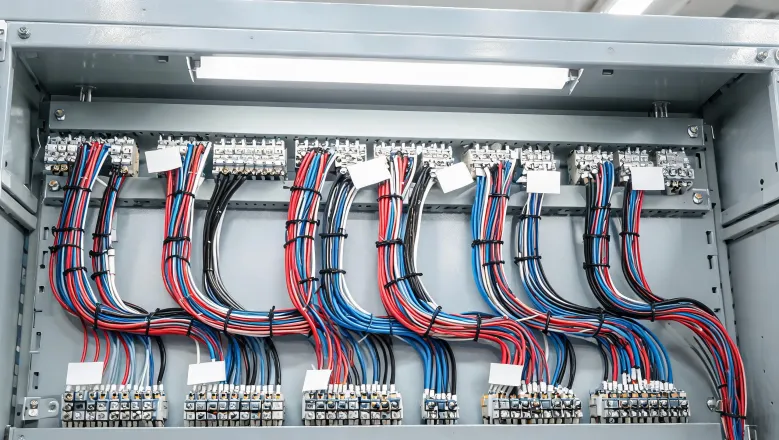
The Surface Problem: You're Buying a Cabinet, Not a System
If you're searching for "what to look for in a electrical cabinet supplier," you're probably comparing IP ratings, enclosure size, metal gauge, and price. That's what I did when I took over purchasing in 2020. I'd get three quotes, choose the lowest number, and move on. Then the electrical contractor would ask where the cable ties were. I'd search "Panduit cable tie" at the last minute, order overpriced overnight, and hope it showed up in time.
The surface problem is that an enclosure is not one item. It's a system: the box, the gland plates, the DIN rail, the grounding, and the cable management. But most of us start by buying the box and then treat everything else as an afterthought.
The Deeper Problem: Cable Management Is an Afterthought
After 5 years of managing procurement for a 40-person integration company, I've come to believe that the "accessory" mindset causes more project delays than any enclosure shortage ever did.
The deeper issue is that cable ties, mounts, and marker labels are rarely included in the specification conversation. You'll see "Panduit cable tie mounts" in a bill of materials, but no one checks whether the mount is for adhesive or screw mounting, whether it's nylon or stainless, or whether the tie width matches the mount slot. Then the parts arrive, and they physically don't fit together.
Part of the problem is fragmentation. Too many of the suppliers I've dealt with can quote a box, but they don't carry cable management. So you end up with two purchase orders, two minimums, and two freight charges. When something doesn't match, each supplier points to the other. It took me four years and roughly 150 orders to understand that a cable tie is a specification, not a commodity.
I don't have hard data on industry-wide order mismatches, but based on our own projects, my sense is that at least 10% of our accessory orders have had some kind of compatibility problem. That number got worse whenever I ordered in a hurry. There's a reason Panduit's published specs—available on their website as of January 2025—list tensile strength, operating temperature, and material for each part number. You cannot look at a generic photo and assume a 14-inch tie has the same properties as a 48-inch tie. But unless a supplier forces that information in front of you, it's easy to skip it. Specs can change, so verify current details at panduit.com.
If you're ordering a full box of 100 cable ties, you can't inspect each one before committing. That's why part numbers matter more than photos. A bulk box is only a good deal if the part inside is the one the drawing calls out.
When I say "accessory," I do not mean optional. I mean underestimated.
What This Really Costs (Not Just in Dollars)
Let me give you a concrete example. I had 2 hours to decide before a vendor deadline on a rush enclosure order for a food-processing job. Normally I'd verify every accessory line against the drawings, but there was no time. I assumed the cable ties were standard. The quoted ties were too short and the cable tie mounts were adhesive-backed on a surface that needed screw mounts. Our team had to drill into the enclosure liner (ugh), install backup plates, and make a second emergency purchase.
The rework cost about $1,800 in labor and expedited shipping. The "savings" from using the supplier's generic cable ties in the quote was $14. I wish I had just asked for Panduit cable tie bulk boxes from the start.
That job was delayed by a day and a half. The client's maintenance window closed, so we had to reschedule a second shutdown. I don't add that into the $1,800 figure, but it's real. When you calculate what to look for in a supplier, this is the kind of cost that never appears on the purchase order.
That's the pattern I see again and again. We compare the wrong number. The upfront price of a box gets all the attention, while the real cost of bad cable management hides in rework, downtime, and last-minute invoices that finance has to explain.
There's also a softer cost: trust. When I approved that rush order, my operations manager didn't blame the supplier. He looked at me. It took a while to rebuild that credibility. If you're an administrative buyer working with engineers and electricians, you know exactly what that feels like.
The Checklist I Use Now
After the third mistake, I built a 12-point checklist. It has saved us an estimated $8,000 in potential rework. The core of it is simple: verify before you approve. This is prevention over cure. It costs little to check; it costs a lot to correct.
- Check the enclosure model against the actual drawing—not the product title.
- Confirm Panduit cable tie mounts match the surface and the tie width.
- Ask for the manufacturer's datasheet for every Panduit component, not a one-line description.
- Check whether the supplier can quote a Panduit cable tie bulk box without making it a separate headache.
- Get lead time in writing. "In stock" is not a lead time.
5 minutes of verification beats 5 days of correction. I know it sounds like a cliché, but I've lived both sides.
What to Look for in an Electrical Cabinet Supplier
So what do I look for now? I want an electrical cabinet supplier who treats cable management as part of the solution, not as a spare part.
First, when I open their box catalog, I should be able to find an enclosure and a Panduit cable tie bulk box in the same search. If I can't, that tells me I'll have to manage the compatibility problem on my own. Second, I ask how they handle compliance documentation. If they can't provide datasheets, they're not a spec-compliant source.
Also, one-stop sourcing isn't about vendor loyalty. It's about forcing accountability. When one source owns the enclosure and the cable management, they can't tell you the compatibility issue is someone else's problem.
Third, I want someone who can guide me on "what to look for in a electrical cabinet supplier" without giving me a generic sales pitch. That means asking me questions: What environment is the cabinet in? What cable types? What order quantity? That's more valuable than a product list.
Find a supplier who treats cable management as a first-class decision, not a last-minute add-on. The cabinet is the skeleton. Cable ties and mounts are what make it hold together.