Skip the sales pitch. Here's the short answer.
If you're sourcing bulk electrical cabinets, enclosures, or junction boxes for wholesale or OEM use, the three things that matter most are: certified compliance paperwork, OEM/private-label capability, and whether your supplier can bundle Panduit cable ties, mounts, and installation tools in the same order. Unit price is fourth — I know that sounds backwards, but I'll explain why in a minute.
I've been coordinating rush orders at an electrical equipment wholesale company for six years. In that time I've handled 200+ emergency orders, including same-day turnarounds for OEM clients and panel builders who discovered a spec mismatch the day before installation. I've seen what goes wrong when buyers pick on price alone, and what a good supplier relationship actually looks like when the deadline tightens.
Why certification beats price — every time
Here's the thing most first-time buyers get wrong: an electrical enclosure isn't a commodity. The same-looking steel box from two different vendors can carry completely different certifications, and that difference only shows up during an inspection — usually at the worst possible moment.
For industrial control panels in the U.S., the relevant standard is UL 508A (Underwriters Laboratories, ul.com). For enclosure environmental ratings, you're typically looking at NEMA 250 types (1, 3R, 4, 4X, 12, etc.) from the National Electrical Manufacturers Association, or IEC 60529 IP ratings if you're serving international clients. A supplier who can't produce a UL file number or a NEMA type verification on request isn't a supplier you want in your bid package.
I don't have hard data on how many import enclosures actually fail first-round inspection, but based on the returns we've processed over the past four years, my sense is that it's somewhere in the 5-10% range for non-certified product lines. That's a guess, not a stat. What I can tell you with confidence: when a cabinet fails inspection on site, the cost of the box is the smallest part of the problem. You're looking at labor, downtime, expedited freight, and — if there's a project penalty clause — potential contract damage.
The documents you should ask for, in writing
- UL 508A listing (for control panel assemblies) or UL 50/50E (for enclosures themselves)
- NEMA 250 type verification or IEC 60529 IP rating letter
- Material certification (cold-rolled steel gauge, 304/316 stainless grade)
- RoHS / REACH declaration if you're shipping to EU clients
- For Panduit branded cable ties and mounts: authorized distributor status, since Panduit does enforce channel compliance
If a wholesale enclosure supplier hems and haws on any of these ("we can send it later," "our factory has it on file"), that's your answer. Move on.
Why I stopped buying on unit price alone
In my first year on this desk, I made the classic rookie mistake: I assumed "standard 16x16x8 enclosure" meant the same thing to every vendor. It does not. I approved a bulk order of 400 boxes from a low-cost supplier and didn't catch the difference in mounting plate thickness and knockout pattern until our client's field crew started installing conduit. Cost us a $600 redo on the plates plus a week of scheduling chaos. We did not have a formal spec-verification checklist back then — we built one immediately after that order.
The lesson wasn't "never buy cheap." It was: compare suppliers on specification match, not on the headline number.
The three-question framework I use now
1. Can they handle OEM and private-label runs?
If you're a distributor or an OEM, you'll eventually want your own branding, custom cutouts, or a baked-on customer-specified color. Some wholesale cabinet suppliers can only sell you what's already on the shelf. Others can run modified orders from 50 units up. Ask directly: "What's your minimum for private-label or custom-cut enclosures?" If the answer is "we don't do that," you've filtered one vendor cheaply.
2. Do they carry Panduit cable ties, mounts, and tools?
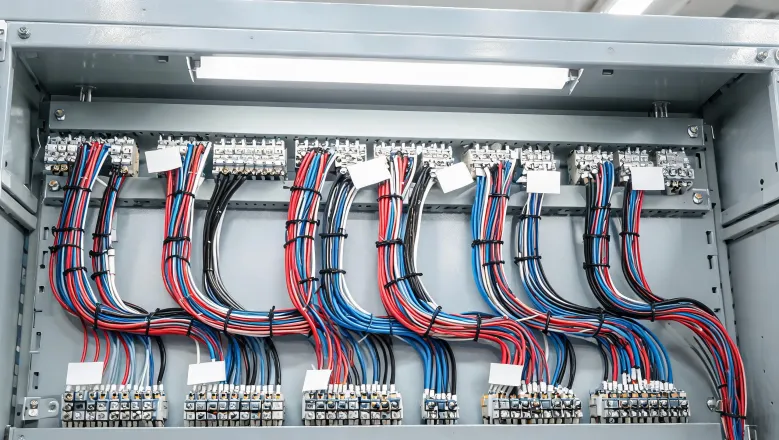
This is a question a lot of enclosure buyers forget to ask. If you're already placing a container order for cabinets, the freight economics of adding a pallet of Panduit cable ties, panduit cable tie mounts, and installation tooling in the same shipment are very different from ordering them separately from a distributor.
That said — be honest about what you're buying. Panduit is a premium brand with strict channel pricing. If a supplier offers "Panduit cable ties" at 40% below list without authorized-distributor paperwork, they are almost certainly not buying from Panduit. Counterfeit and grey-market cable ties exist, and they fail differently than cheap enclosures do. Cheap enclosures fail inspection. Counterfeit cable ties fail in the field, sometimes years later, when the nylon degrades under UV or heat and the bundle lets go.
3. What's the realistic lead time — not the catalog lead time?
Catalog lead times are marketing. Real lead times come from asking: "When did you last ship a 500-unit order of this exact SKU, and how long did it take from PO to dock?" If they can't answer that without checking, they're either new to the product or they're quoting you from a spec sheet.
Where the one-stop sourcing pitch actually holds up
A supplier who can ship enclosures, junction boxes, electrical cabinets, Panduit cable ties, tie mounts, and installation tools on one freight bill does save you real money — but mostly on coordination, not on the unit line items. You eliminate one receiving process, one supplier qualification, and one set of inbound freight allocations. For a mid-size distributor doing 20-30 cabinet orders a month, that overhead adds up to something in the low five figures annually. Not life-changing, but real.
The catch: a one-stop supplier is only as good as their weakest product line. If their enclosures are strong and their cable management is grey-market, you're importing someone else's problem into your own customer relationships. I'd rather split the order across two trusted suppliers than consolidate with one who can't prove chain-of-custody on the brand items.
Where this framework breaks down
Two situations where I'd throw most of the above out the window:
Small local orders. If you need 15 enclosures for a regional job and a local distributor has them in stock, take the local order. Freight and lead time dominate the math at that volume, and certification paperwork for a small custom job can be handled by the fabricator.
Legacy replacement parts. If you're matching an enclosure that's been in service for 15 years, spec-matching to the original manufacturer usually beats any cost optimization. Substituting a "close enough" box on a retrofit is how project managers end up drilling new holes in expensive equipment.
One more honest boundary: I don't have visibility into every regional market. What works for our North American wholesale flow may not translate to EU or APAC sourcing, where ATEX, IECEx, or local regulatory schemes change the compliance picture completely. Verify current requirements against the relevant standards body (UL, IEC, or your regional equivalent) before you commit to a spec.
Spending 20 minutes with a supplier on certification and lead time upfront has saved me more project hours than any price negotiation I've ever run. An informed buyer asks sharper questions and gets faster answers. That's not a sales line — it's just how the math works.