The Short Answer
If you're sourcing Panduit cable ties and Panduit cable tie mounts for an electrical cabinet build with a hard deadline, don't optimize for unit price. Optimize for three things: verified compliance documentation (UL 62275 for ties, UL 1565 for mounts), a distributor who can confirm real-time stock instead of promising "typically available," and a supplier who understands that a $0.03 difference per tie means nothing when a box fails inspection.
That's it. That's the answer most buyers figure out after the first late shipment.
I've coordinated 200+ rush orders over six years at an electrical enclosure company, and I can count on one hand the number of times the cheapest quote was actually the cheapest outcome.
Why I Care About This More Than I Should
In March 2023, a distributor I'd worked with for two years quoted us roughly 18% below our usual supplier on a batch of Panduit cable ties and mounting bases for a 200-unit electrical cabinet order. The project was for a food-processing client with a fixed install date and a penalty clause — $2,500 per day past deadline. We had 11 days.
The ties arrived on day six. Looked fine. Felt fine. But when our QA tech pulled the spec sheet, the ties lacked the UL 62275 listing we needed for the cabinet certification. The distributor had substituted a "comparable" product without telling us. The mounting bases had no UL 1565 listing at all.
We had four days to find certified replacements, pay expedited freight, and rework 60 cabinets that had already been partially assembled. Total damage: around $4,200 in overtime and air freight, plus a very uncomfortable call with the client. The "savings" from that cheaper quote? About $380 across the whole order.
I think about that number every time someone sends me a spreadsheet comparing quotes by unit price alone.
What Actually Matters When You're Against the Clock
1. Compliance documentation isn't paperwork — it's your liability shield
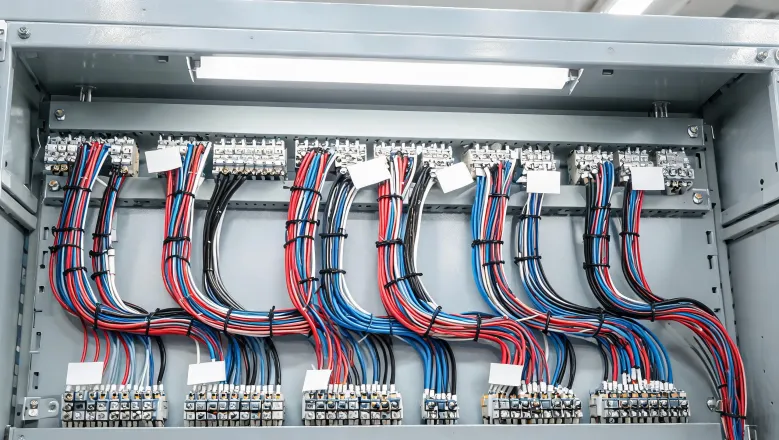
Box compliance requirements for electrical enclosures aren't uniform. Depending on your end application, you're looking at UL 508A for industrial control panels, NEMA 250 ratings for environmental sealing, and — specific to cable management — UL 62275 for cable ties and UL 1565 for cable tie mounts.
Panduit's standard nylon 6.6 ties carry these listings. But listings apply to specific product families, not to "Panduit cable ties" as a general category. If a distributor can't tell you the exact series number and the corresponding listing, that's a red flag.
"I need the UL file number for the specific tie series you're shipping." If they hesitate, ask for samples and verify independently. It takes 10 minutes and it's saved me twice.
2. Stock verification beats stock promises
There's a difference between "we have Panduit cable ties in stock" and "we have 15,000 units of Panduit BT2S-C in our Ohio warehouse, confirmed this morning." One is a sales answer. The other is a shipping answer.
During our busiest season — Q3 2024, when three OEM clients needed accelerated delivery on cabinet builds — I started requiring lot-level stock confirmation before releasing any purchase order. Not because I don't trust suppliers. Because I'd been burned by "available" before.
The distributors worth keeping are the ones who volunteer the warehouse location and the count without being asked. That's not customer service. That's operational competence.
3. Mounts are the bottleneck, not ties
Everyone stocks cable ties. Not everyone stocks Panduit cable tie mounts in the specific adhesive-back or screw-mount configurations your cabinet design calls for. And when you're bundling wire runs inside a control cabinet, you're going through mounts fast — often faster than ties.
I've had three rush orders in the past 18 months where the ties shipped same-day but the mounts added 4-6 days. One of those delays nearly cost us a $15,000 project. (Should mention: we now order mounts at a 15% overage on every job. Better to have extras than to wait on a second shipment.)
If your electrical enclosure manufacturer can't source both ties and mounts from the same distributor, you're adding a coordination layer that will eventually fail you at the worst possible moment.
The Real Cost of a Rush Order (And Why Cheap Quotes Are Expensive)
Let me walk through the actual math on a recent 48-hour emergency order. Client needed 80 electrical cabinets with full wire management — Panduit ties, mounts, and labels — for a data center fit-out. Their previous supplier had shipped the wrong mount type.
Our cost breakdown:
- Panduit cable ties (BT2S-C, 10,000 units): base cost around $340
- Panduit cable tie mounts (TM2S8-C, 3,000 units): base cost around $510
- Expedited freight from distributor warehouse: $680
- Overtime for our assembly team (two nights): $1,900
Total rush premium: roughly $2,580 on top of the base order. Our client's alternative was pushing the data center handover by a week — which would have triggered a $12,000 contract penalty.
So yes, we paid nearly $2,600 extra. And it was still the right call.
But here's the part that matters: the distributor who filled that order wasn't the cheapest quote we received. They were the only one who could confirm certified stock, ship within four hours, and provide the compliance documentation our client's inspector required. The cheaper quote came from a distributor who "could probably" get the mounts by Thursday. I've learned not to gamble on "probably."
The Mindset Shift That Changed How I Source
I didn't fully understand the difference between price and cost until that March 2023 substitution incident. Before that, I treated unit price as the primary variable and everything else — lead time, certification, stock reliability — as secondary considerations I could manage around.
I was wrong. Those "secondary" factors are the cost. Unit price is just the sticker.
Now I evaluate distributors on a simple framework:
- Can you confirm certified stock right now, with quantities?
- Do you carry both Panduit cable ties and Panduit cable tie mounts in the series we specify?
- What's your actual same-day cutoff time for rush orders?
- Can you provide compliance documentation before shipment, not after?
If a distributor can answer all four, I don't care if they're 5% more expensive. That 5% buys me certainty, and certainty on a deadline-driven project is worth more than the line-item savings.
There's something satisfying about a rush order that lands clean. After years of the scramble-and-pray approach, finally having a vendor who can actually deliver on a 48-hour window — that's a different kind of relief. Not excitement. Just the quiet confidence that the phone isn't going to ring at 11 PM with bad news.
When This Approach Doesn't Apply
I want to be honest about the boundaries here, because I've seen this advice get misapplied.
If you're not on a deadline, the calculus changes. For planned orders with 6-8 week lead times, unit price matters more. You can afford to wait for the cheapest qualified supplier, and the savings add up across high-volume runs. The rush-order framework I described above is specifically for compressed timelines — the kind where a day's delay costs more than a month's worth of unit-price savings.
If your compliance requirements are minimal, some of this doesn't apply. Not every cabinet build needs full UL listing documentation. Some applications — low-voltage enclosures, non-critical installations — have thinner compliance requirements. But I'd argue the documentation is still worth having. It costs you nothing to ask for it upfront, and it costs a lot to need it later.
And if you're evaluating a new distributor, don't start with an emergency order. Test them on a standard timeline first. See how they handle a routine shipment before you bet a project deadline on their rush capabilities. I have mixed feelings about this — it feels slow when you just need a solution now. On the other hand, I've seen too many last-minute switches to unfamiliar vendors end badly. I compromise by running a small trial order in parallel with my existing supplier. Gives me data without the risk.
The cheapest Panduit cable tie is the one that works. The most expensive is the one that fails. Everything else is just arithmetic.