The Problem You Think You Have: Suppliers Are Unreliable
In September 2022, we placed an order for 340 junction boxes with a new supplier. Specs were confirmed. PO was signed. Lead time was agreed. The shipment arrived with 42 units that wouldn't fit—because the cutout dimensions were wrong. Not the supplier's mistake. Ours.
But it took me months to see that.
Before then, I blamed the supplier. I blamed the sales rep. I blamed an industry where everyone cuts corners to hit a price. Then I ran the numbers: six years, seven suppliers, roughly $14,000 wasted on rework, expedited freight, and scrapped material. That's when it hit me—the problem wasn't on their side. It was on mine.
If you're reading this, you're probably looking for an honest enclosure distributor buying guide—or you just received another shipment that went sideways and you're trying to figure out why. Most people dealing with an electrical cabinet distributor eventually reach the same conclusion: "Suppliers are just unreliable." I don't blame them. I thought the same thing. But when I actually dug through our records, I found something more uncomfortable: the problem almost always started before the PO was sent—on our side of the table.
The Deeper Reason: You're Treating Electrical Enclosures Like Commodities
Here's what nobody wants to admit. Electrical enclosures—junction boxes, cabinets, housings—look like commodities. A box is a box. It's there. You order it, it arrives. How complicated can it be?
Very. And that assumption is what causes most of the problems.
Here's why:
1. You're not buying a box—you're buying a spec sheet
An enclosure is defined by dimensions, material, protection rating (NEMA Type or IP rating), mounting style, and compliance certifications. According to NEMA 250, enclosure Types range from Type 1 (indoor, dust-tight) to Type 4X (corrosion-resistant, washdown). You can't fully specify any of that on a purchase order.
Yet most people write "16×14×8 in, steel, gray door with crossmark." That's what the supplier works from.
Here's the problem: every supplier interprets that spec slightly differently. One assumes 14-gauge steel. Another assumes 16-gauge. One thinks hinges are standard. Another thinks they're an upgrade. By the time you find out, the units are already on a truck.
I learned this the hard way. Our junction box order specified "3/4-inch cutouts." The supplier—reasonably, but wrongly—assumed standard placement instead of the custom layout we needed. 340 units, 42 scrapped. We paid for rework and ate a three-day production delay. That error cost us $2,300 in redo costs plus the scheduling headache.
Everything I'd read about procurement said get multiple quotes and pick the cheapest. In practice, across 200+ orders, I found that relationship consistency often beats marginal cost savings. The supplier who knows your specs already is worth more than the one who quotes 5% lower. That's not conventional wisdom. But it's what the data showed.
2. "Electrical cabinet distributor" and "distributor" are not the same thing
This took me years to understand. A lot of people—myself included—use "distributor" as a catch-all label. But not everyone selling enclosures operates the same way.
Some companies stock and ship: they buy standard products, keep them in a warehouse, and fulfill from inventory. Others specialize in OEM and custom work: they build to your spec or drop-ship from a factory. And some are hybrid: they carry some stock but mostly resell.
If you don't understand which model you're dealing with, you get burned. You might assume a company has stock, only to find out they order from the factory after you place your PO. Or you assume they can do custom modifications, only to discover they're just passing through standard catalog items.
This sounds basic, right? But nobody tells you this until you're on the third phone call about lead times. Lead time isn't a promise—it's a conditional estimate.
3. Panduit cable ties are not commodity cable ties
Now let's talk about cable ties. This is where most people really get burned.
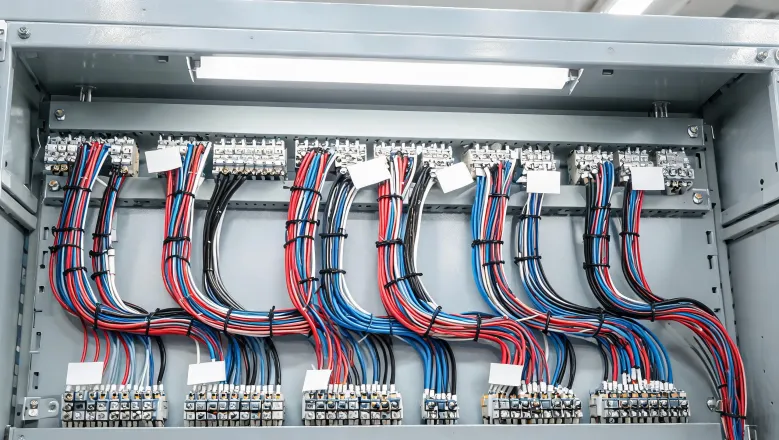
A Panduit cable tie is part of a system—different materials (nylon 6.6, stainless steel, Teflon), different tensile strengths, different mounting methods, and a whole range of installation tools that matter as much as the ties themselves.
But a lot of buyers treat them like generic zip ties. "Just get a bag of Panduit cable ties and call it a day." The problem is that Panduit cable ties are engineered for specific use cases. If you pick the wrong model—say, standard nylon where UV resistance is needed—they can fail within months. If you use the wrong installation tool, you might over-tension and crush cables or under-tension and leave ties loose.
And specifically, Panduit cable tie mounts—the little bases that hold cables to panels—are often treated as an afterthought. But they're the critical point. Use the wrong type or the wrong adhesive and the whole install fails. I once watched a project where the mounts peeled off the backplate two weeks after delivery. Imagine the customer opening a cabinet and seeing cables just hanging there. That was an $3,800 callback.
I assumed "same specs" meant identical results across vendors. Didn't verify. Turned out each had slightly different interpretations. Especially with Panduit cable tie selections, even something like "nylon 6.6" can vary in UV stabilization or tensile rating depending on the source.
4. Lead time isn't a promise—it's a conditioned estimate
"Delivery in two weeks." We hear that and we mentally lock it in. Then we schedule projects around it. Day 10 we check the tracking. Day 14 we call. Day 18 it arrives—minus some items.
The problem isn't that anyone lied. It's that "two weeks" means "if we have it in stock, and if no other orders jump the queue, and if the freight carrier doesn't go on strike." It's conditional. But on a PO, it looks like a commitment.
When you're juggling multiple projects and multiple suppliers, these conditional estimates stack up fast. One delay bumps an install, which bumps client acceptance, which bumps payment. The ripple effect costs way more than the line item.
What It Costs When You Don't Fix It: The Ledger Doesn't Lie
Let me pull the actual numbers. I've documented every significant procurement error over six years. As of Q1 2024:
- Rework from spec mismatches: $6,400 across nine orders
- Expedited and air freight: $2,900 to recover delayed timelines
- Scrapped material: $3,100—mostly ties and mounts that couldn't be used
- Damaged customer relationships: two accounts lost, no repeat business over three years
That's roughly $14,000—but it doesn't include the hardest part to quantify: the hours spent on phone calls, emails, insurance claims, and internal post-mortems trying to figure out what went wrong.
And then there's compliance risk. Under UL 508A, industrial control panels have specific component and construction requirements. If the enclosure doesn't meet the specified rating, the whole panel can fail inspection. That's not a few hundred dollars in rework—that's an entire project do-over.
And be honest with yourself: how much of your own time are you spending managing this mess? Our team estimated about six hours per week on firefighting. That's 24 hours a month—time spent on problems that shouldn't exist.
Even after you choose a new vendor, the second-guessing doesn't stop. What if their quality isn't as good as the samples? The two weeks until delivery are stressful. In hindsight—if the specs had been locked down from the start, none of that anxiety would have existed.
The Fix: A Short Checklist (That's It)
I'm not going to give you a 30-page process manual. Three steps. But if you do them every time, you'll avoid most of what I went through.
Write specs as a checklist, not a summary. Before sending a PO, confirm each item: dimensions, material, protection rating, cutout requirements, mounting style, and certification requirements. Have the supplier sign off. One missing spec can scrap an entire batch.
Understand which model your supplier runs. Are they a stocker, a manufacturer, or a reseller? That determines whether your lead time is realistic. Ask directly. "Do you stock or build to order?" The answer tells you how much buffer you need.
Treat cable ties as components, not accessories. Confirm part numbers, confirm installation tool compatibility, confirm environmental conditions (UV exposure, temperature, vibration). Panduit cable ties and mounts have specific install specs—ignore them and they fail early.
That's it. Nothing fancy. Just the stuff that keeps you from shipping the wrong thing.
Actually, there's a fourth thing, and it matters more than all the others: stop and admit you're the problem. Not the supplier—you. You're the one who treated "enclosure" as a simple word instead of a set of engineering requirements that need to be defined. You're the one who used "distributor" as a generic label instead of verifying what they actually do. You're the one who assumed a cable tie is a cable tie.
Once you accept that, the rest takes care of itself.