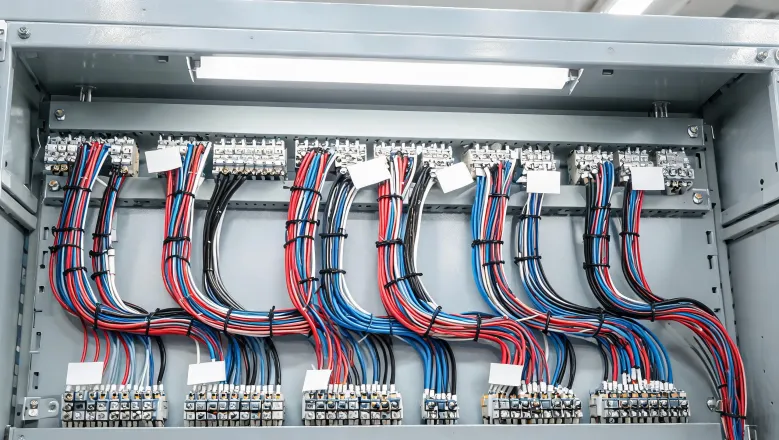
I've been handling electrical enclosure and cable management orders for about 9 years. In that time I've made — and documented — 14 significant sourcing mistakes that added up to roughly $67,000 in wasted budget. Not proud of that number. But it's why I now keep a pre-purchase checklist taped next to my monitor.
Here's the thing nobody tells you when you're buying Panduit cable ties alongside bulk electrical enclosures: there is no universal "right" answer on brand, channel, or volume. It depends entirely on which scenario you're in. I've watched people argue for 45 minutes in a meeting about Panduit vs. equivalent ties when they were actually in completely different situations and neither realized it.
So let's break this down. Three scenarios. Three different playbooks.
The Three Scenarios (And Why the Distinction Matters)
Before we get into specifics, here's the quick version:
- Scenario A: Your spec sheet literally says "Panduit" — zero flexibility
- Scenario B: Your spec says "Panduit or equivalent" — and you have real choices to make
- Scenario C: You're bundling enclosures, ties, mounts, and tools into one procurement — and need to think about the whole system
Most of the arguments I've seen come from people in different scenarios using the same logic. That's like comparing a custom-machined part to a catalog order. Not the same game.
Scenario A: Spec-Locked on Panduit (No Wiggle Room)
If your drawing, BOM, or customer spec specifically calls out "Panduit cable tie" by name — not "or equivalent" — you're in Scenario A. This happens more than people think, especially in aerospace, rail, and any project where the end customer has standardized on Panduit for traceability reasons.
My advice here is simple, and honestly a little boring: buy from authorized channels, negotiate what you can on volume pricing, and don't try to get clever.
In 2019, we had a project manager who thought he could save about $500 on a 12,000-piece order by sourcing "Panduit-equivalent" ties from a third-party marketplace. The ties looked right. Packaging looked right. Even the color matched. But the customer's incoming inspection flagged them because the batch traceability didn't come through Panduit's official system. The entire shipment got rejected. Redo cost us about $1,400 plus a two-week delay on the build schedule. He doesn't work here anymore, but that's not the point — the point is that $500 "savings" had a TCO of roughly $2,200 once you factor in the return shipping and the expedite fee on the replacement order.
"Even after choosing the authorized channel, I kept second-guessing. What if we could've gotten the same ties for 15% less through a broker? The three weeks until the customer's inspection sign-off were stressful."
The relief when that inspection passed? Enormous. But the lesson was real: when the spec says Panduit, the spec says Panduit. Your job is to negotiate volume, payment terms, and lead time — not to reinterpret the requirement.
Scenario B: "Panduit or Equivalent" — Where TCO Actually Lives
This is where most of my hard-won lessons came from. When the spec says "Panduit cable tie or equivalent," a lot of buyers immediately jump to the cheapest option that meets the written dimensions and tensile rating.
That's the wrong instinct.
I'm not saying you should always buy the premium option. I am saying that a cable tie's purchase price is maybe 30-40% of its actual cost in a production environment. The rest is installation labor, rework rate, and the risk of a batch failing inspection months later.
In Q1 2022, we ran a controlled comparison on one production line. Half the line used Panduit ties at roughly $0.11/unit. The other half used a qualified equivalent at about $0.07/unit. On paper, the equivalent saves 36%. Sounds great, right?
Except here's what actually happened over three months:
- Installation labor on the equivalent ties was about 22% higher — the locking mechanism needed more force to seat properly, and workers were fumbling more
- Our defect rate (ties that didn't fully tension or slipped) went from 1.8% to roughly 6% on the equivalent side
- One production run of about 800 units had to be partially reworked because the ties didn't hold tension through a vibration test
When we added it all up — the extra labor, the rework hours, the rejected units — the "cheaper" equivalent ties cost us about 14% more per unit than the Panduit ones.
Never expected that. Turns out the price difference was real, but the process cost delta was bigger.
So the TCO formula that I now use before comparing any two cable tie options looks roughly like this:
True cost per unit = purchase price + (extra install seconds × labor rate) + (defect rate × rework cost) + (inspection failure risk × redo cost)
You won't always have perfect numbers for every variable. But even rough estimates will change your decision more often than you'd think. And I say this as someone who used to just look at the unit price column and pick the smallest number.
Scenario C: Bundled Sourcing — Enclosure + Cable Management Together
The third scenario is the one that's become most common in my work over the past few years. You're not just buying cable ties. You're buying bulk electrical enclosures, junction boxes, mounting hardware, Panduit cable tie mounts, and installation tools — and someone upstairs has decided this should all come from one supplier to "simplify things."
Here's where the conventional wisdom gets tricky.
The standard move is to send your full BOM to three or four enclosure manufacturers and ask for a package quote. Then compare the bottom-line numbers. This is what I did in 2021 on a roughly $85K order. Four vendors. Two weeks of back-and-forth. We picked the lowest total.
The surprise wasn't the price difference between vendors. The surprise was how much hidden cost came from managing four things that didn't quite fit together.
The enclosures arrived on time. But the cable tie mounts we'd specified had a slightly different hole pattern than the enclosure's pre-drilled mounting points. Not a dealbreaker — but it meant our assembly team had to drill out about 3,000 holes across the batch. That's maybe 40 extra labor hours we didn't budget for. Plus a fair amount of frustration.
The most frustrating part of bundled sourcing: the same issues keep recurring despite clear specs. You'd think "3mm mounting hole, 25mm spacing" would be universally unambiguous, but interpretation varies wildly between suppliers — especially when they're sourcing parts from different sub-suppliers.
After that order, I changed our approach. What I now do is this: I'll still ask for a bundled quote, but I also ask each vendor to break out the cable management components separately and confirm fit compatibility with their enclosure line. If a vendor can't confirm that their Panduit cable tie mounts are compatible with their own enclosure mounting pattern, that's a red flag — not about the product, but about how well they know their own system.
The one-stop-shop premium is real — usually 5-10% on the bottom line versus piecing it together. But in my experience, that premium is almost always cheaper than the coordination cost of multiple suppliers whose parts don't actually fit together the way the drawings suggest.
How to Figure Out Which Scenario You're Actually In
Here's the checklist I use. Takes about 90 seconds:
- Read your spec sheet. Does it say "Panduit" or "Panduit or equivalent"? If it's the former, stop — you're in Scenario A. Negotiate volume and terms only.
- Count your suppliers on this order. If it's more than two, you might be in Scenario C and not realizing it. Bundled sourcing has its own logic and its own cost structure.
- Ask: what's the cost of failure? If a rejected batch means a customer escalation meeting, Scenario B logic applies — TCO, not unit price. If a rejected batch means "we'll swap them next week," you have more flexibility than you think.
- Check whether your team actually installs these or just resells them. If you're reselling, unit price matters more than install labor. If you're installing, labor dominates the TCO equation. This one variable changes the answer more than anything else on this list.
I've been wrong on this long enough to know that the "right" sourcing strategy for Panduit cable ties and bulk enclosures isn't about finding the best price. It's about correctly identifying which game you're playing before you start comparing quotes. Get that wrong, and you'll win the price battle while losing the cost war.
And I say that as someone who's lost that war about 14 times. The checklist helps. Most of the time.