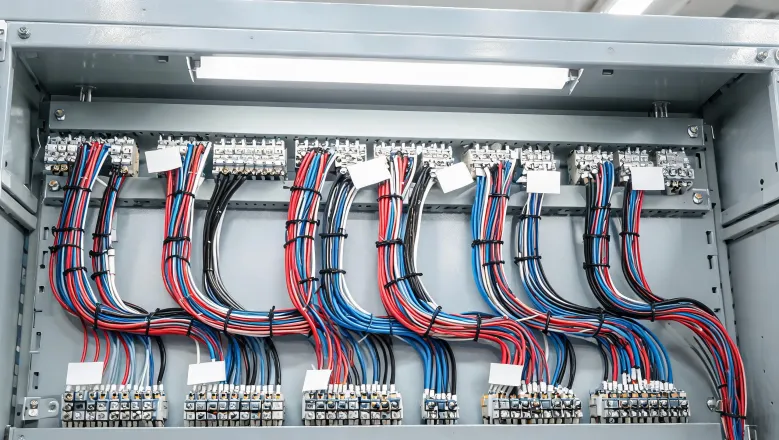
I'm going to lead with the conclusion because it took me six years and about $180,000 in cumulative procurement spend to learn it: The lowest quote on Panduit cable ties—or on enclosure wholesale pricing, for that matter—is almost never the lowest total cost. Hidden fees added 12–18% to our annual purchasing costs in the years when I didn't run a proper TCO analysis. That's the difference between a clean budget year and an overrun that gets you a lecture from finance.
I'm the procurement manager at a 90-person electrical distribution company. I manage around $45,000 annually in cable management and enclosure products, with Panduit cable ties as our highest-frequency SKU and junction boxes / electrical cabinets as the highest-value line. I've negotiated with 30+ vendors, logged every order in our cost tracking system, and built enough spreadsheets to make the operations team roll their eyes. If there's a fee hiding in a distributor's quote, I've probably involuntarily funded it at some point.
What I got wrong about Panduit cable tie pricing
When I started in this role, I assumed the lowest unit price on a bag of Panduit cable ties was the win. Three budget overruns later, I started asking for all-in pricing on every quote. Different picture.
Concrete example from Q2 2024: we evaluated quotes from four distributors for our standard order—10,000 pieces of Panduit Cable Ties (PLT1.5I-M, 4-inch nylon 6.6). The first distributor quoted $58 per thousand. The second quoted $51 per thousand. Same product, same quantity, same delivery window. I almost signed until I asked for a full cost breakdown.
The cheaper quote came with an $85 processing fee for split shipments, a $42 documentation fee for the certs we attach to our UL-listed enclosures, and freight that was 25% higher because their warehouse isn't on our standard shipping lane. That turned a $70 unit-price advantage into a $214 annual cost increase. A 17% escalation hidden in the fine print (which, honestly, made me furious when I spotted it). The point isn't that this distributor was dishonest—it's that "processing," "documentation," and "freight" are part of the price.
Panduit cable tie mounts: the line item everyone skips
Buyers negotiate hard on the ties themselves, then accept whatever number gets attached to adhesive mounts, screw mounts, and standoff mounts—as if mounting hardware is an afterthought. It isn't.
We learned this the hard way. Adhesive mounts (like the Panduit ABM2S-A-L) look cheap until you account for surface prep. On our assembly line, we switched to screw-mount variants and cut installation time by about 20%. The screw mounts cost more per piece; the labor savings outweighed it.
There's also the compatibility problem. A tie's tensile rating means nothing if the mount fails first. We once had a batch of generic mounts fail inside a customer's panel at 60°C while the tie was rated for 90°C. The $150 we saved on parts turned into a $1,200 field rework. Our spec sheet now requires tie and mount to meet the same temperature rating.
Bundling helped here too. Once we started ordering ties, mounts, and installation tools under a single distributor agreement, we had volume leverage that didn't exist when those purchases were split across three vendors. Our current blended cost on mounts is in the ballpark of 11–14% below 2022 levels—though, don't hold me to the exact percentage, because we renegotiated in 2023 and the market has moved since.
Enclosure wholesale: the spec drives everything
Electrical enclosures aren't a commodity like cable ties. A box, junction box, or electrical cabinet is a spec-driven product, and the spec determines how much room a distributor has to discount.
The mistake I made for my first two years—and that I still see other box distributor customers making—is sending a vague RFQ: "What's your wholesale price on junction boxes?" The distributor doesn't know what you need, so they quote their most common catalog box with extra margin tacked on to cover their uncertainty. Then the volume discount looks terrible because the quote was never apples-to-apples.
Before you ask for wholesale pricing, lock down these four variables:
- Material and finish—painted carbon steel, stainless, fiberglass. Each is a different cost universe. Per FTC guidance on marketing claims (ftc.gov), don't accept a vendor's generic "suitable for industrial use" phrasing. Ask what standard the finish meets (UL 50, NEMA 250, etc.).
- Environmental rating—a NEMA 12 box and a NEMA 4X box are not cousins. Moving from one rating to another can shift unit price by 30–60%.
- Quantity band—in our order history, the steepest price breaks start at 50+ units on standard catalog boxes. Custom cutouts or special colors erode discounts and stretch lead times.
- OEM / private label—if you're buying enclosures as components for your own product, private labeling changes the cost structure entirely. Setup costs get amortized differently, and the decision shifts from unit price to lifetime cost.
My experience here is based on roughly 200 purchase orders in the 50–500 unit range, mostly with domestic wholesale distributors. I can't speak to container-scale importing or distribution outside North America—different cost drivers entirely.
Bundling, efficiency, and the digital layer
Conventional wisdom says split your purchases to keep suppliers honest. I've also watched that advice backfire. The fixed costs of purchasing—RFQ processing, order reviews, incoming inspection, freight coordination—get multiplied for every additional supplier. Three vendors means three purchasing cycles, three freight minimums, three sets of admin overhead.
In our case, the enclosure distributor also supplies Panduit cable ties and mounts as bundled line items at a combined quote about 9% below our previous split-vendor arrangement. Freight went down because it's one delivery, not three. We've verified part numbers, lot codes, and packaging against Panduit's published specs. If you need the formal assurance of Panduit's official warranty, authorized distribution might be worth the premium—that's a legitimate trade-off, and it depends on your risk profile.
The efficiency play was the real game changer, though. In late 2023, we moved from email-based RFQs to an ERP-integrated procurement module with order history tracking. It cut our quote-to-order cycle from five days to two. It also surfaced a pattern I'd missed for years: we were consistently overpaying on small fill-in orders of Panduit cable ties. Shipping small packages via USPS Priority Mail often cost more than the bag of ties inside. According to USPS rates effective January 2025 (usps.com), a Priority Mail Small Flat Rate Box costs $10.40—add that to a $15 bag of cable ties and the effective per-unit cost jumps threefold. We adjusted reorder points to minimize fill-ins, and emergency order volume dropped by 60%.
I'm not 100% sure the same digital playbook works for every company. Decentralized procurement or very small volumes might not justify the setup time. But if you're running more than a few orders per month, the visibility alone pays for itself.
When to ignore this advice
The TCO approach assumes defined specs, predictable volumes, and a stable supplier. There are edge cases:
Expedited needs. If you need a cable tie or a junction box same-day, price analysis goes out the window. Call a local electrical distributor with counter sales and pay the premium. (The "expedited" option once added 50% to our cost, which honestly felt like robbery, but the alternative was a line shutdown.)
Specialty environments. Extreme temperatures, chemical exposure, UV exposure—those call for stainless steel ties, ETFE ties, or fiberglass enclosures. Completely different pricing logic.
Non-critical applications. If you just need to tidy up wires in an indoor, dry, low-temp environment, generic nylon ties at half the Panduit price are probably fine. We buy generics for our own office racks. But when a customer's enclosure is going into a production line, we stick with traceable brands.
One more boundary: the numbers I've cited were accurate as of Q4 2024. Distributor fee structures change, Panduit revises its catalog, and steel prices move. Get fresh quotes before you lock in any 2025 wholesale agreement, and run your own TCO numbers. Take mine as directional, not gospel.
There's something satisfying about finally getting the process right. After the early years of second-guessing every invoice, our current system lets me review a quote in fifteen minutes instead of half a day. No more 3 a.m. worry sessions about whether the shipment will arrive. That, honestly, might be the most valuable cost-saving measure of all.