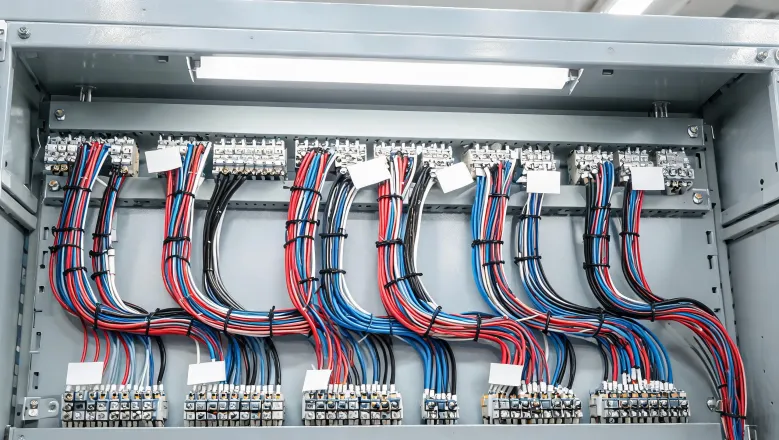
The order looked fine until I zoomed in
At 8:40 on a Tuesday in February 2024, I was doing what I do every time a pre-shipment photo lands in my queue: zooming in on details that nobody else seems to care about. The photo showed a control cabinet from a 200-unit bulk electrical cabinet order. It had Panduit cable ties in place. The harnesses were clean. The back panel looked right. Then I saw the cable tie mounts.
I'm the quality and compliance manager at an electrical enclosure and cable management company. Not Panduit, to be clear. I review the cabinets, boxes, and accessories we ship to OEMs and wholesale customers—roughly 250 unique items a year. In 2024, I rejected about 4% of first deliveries, usually because the documentation was off and sometimes because the hardware was off. This one was hardware.
Since I implemented our verification protocol in 2022, pre-shipment photos are mandatory for orders at this size. That photo is why I had the evidence. The spec called for Panduit cable tie mounts, screw-mount type, on the internal panel. The photo showed adhesive-backed mounts. (Thankfully, the photo was sharp enough to tell.)
So I called the lead engineer. His first response was They looked the same in the model. They weren't.
How we reached that point
When I first started in this role, I assumed a cable tie was a cable tie. The enclosure was the expensive part. The accessories were the easy part. Two years later, my view is different: accessories are where specifications go to die.
As a box distributor, I can't just compare unit prices. I have to compare what happens after the cabinet is installed. The order in question started back in November, when a customer asked for 200 bulk electrical cabinets for an assembly line near a drying oven. Their written spec said Panduit cable tie mounts and Panduit cable ties. Our purchasing group looked at the line item and treated it as a brand preference. A comparable mount was cheaper. A comparable tie was cheaper. It looked like a no-brainer on paper.
But then again, that's the word that causes the trouble: comparable.
A cable tie has measurable things: width, tensile strength, material, temperature rating, flammability rating. So does a mount. The substitute matched the length and width. It also had a sticky backing instead of a screw hole. In a panel that can see vibration and heat, that's not cosmetic. Put another way: it was the wrong product for the environment. At least, that's been my experience with industrial enclosure orders.
I'm not saying never substitute. I'm saying substitution needs approval before it goes on a PO, not after production starts. On a static data rack in a cool room, an adhesive mount might be fine. That wasn't this application.
A $600 savings that almost became a $22,000 redo
The alternate mount quote we received in January 2024 was roughly 40% lower. On 5,000 pieces, that gave us a ballpark savings of $600. That sounds real until you add the other side of the ledger.
In Q3 2023, we had a similar substitution slip through on a smaller order. A customer's enclosure supplier used an adhesive mount in a spot where the spec called for screw-mount. The mount held during the bench test. It let go during a field startup. That quality issue cost us a $22,000 redo and delayed the customer's launch. The root cause wasn't a broken mount. It was the assumption that an equivalent component could silently replace a specified one.
When I flagged the 200-cabinet order, the supplier's first response was that the parts met the same dimensions. They did. But the spec wasn't about dimensions when it said screw-mount. It was about keeping the wiring supported after years of heat and vibration. In that context, an adhesive mount is a deal-breaker.
We caught it before shipment, so the cost was a five-day delay and a change order. The vendor swapped the adhesive mounts for Panduit cable tie mounts with screw holes. The added cost was about $280 on a much larger order. That's not nothing. But it's a lot cheaper than pulling every harness loose on 200 cabinets after the fact. Plus, the customer didn't need to reschedule a startup crew. (I'll take that as a win.)
What I put in the electrical enclosure specification guide now
Since then, I've added a review checklist to every bulk electrical cabinet guide we share with customers. It's not complicated, but it has to be written down:
- Start with the environment and the standard. According to NEMA 250 (nema.org), enclosure types are defined by the conditions they are designed to protect against. Type 1 is for indoor use, Type 3R for outdoor rain and sleet, Type 4X for corrosive or washdown areas. A cabinet is not a cabinet.
- Lock the accessory spec. If the line item says Panduit cable tie mounts, buy them or get formal approval before swapping. When a PO line item says equivalent without naming who approves it, that's a red flag.
- Verify the cable tie material and ratings. According to UL's Product iQ database (ul.com), permanent cable ties are evaluated under UL 62275. Many Panduit cable ties are made from nylon 6.6 with a UL 94 V-2 flammability rating and a continuous temperature range around -40°C to 85°C depending on product (Source: Panduit product data, accessed January 2025).
- Check the wiring support requirement. The point of a cable tie mount in an enclosure is not just neatness. According to NFPA 79 (nfpa.org), wiring in an industrial control panel needs to be supported so it does not put strain on terminations. A mount that lets go can turn an orderly panel into a safety issue.
- Calculate TCO, not quote price. Price plus rework plus delay plus engineering time plus customer trust. That is the total cost. The $600 savings in that first comparison didn't survive contact with the real install environment.
An 'or equivalent' without a named approving engineer is not a specification; it's a suggestion.
I have mixed feelings about the phrase 'or equivalent.' On one hand, it keeps vendors honest about inflated part numbers. On the other, an uncontrolled equivalent is how a $0.04 component causes a $22,000 redo. These days, my answer is simple: if the customer writes a manufacturer's name in the spec, I keep that manufacturer in the order.
Bottom line: the Panduit cable tie is not the most expensive part of a bulk electrical cabinet order. But the mount behind it, and the process that verifies it, can be the difference between a smooth startup and an expensive one. I'd rather pay $280 now than explain a 200-cabinet rework later.
That's the part I didn't understand when I first started reviewing enclosures. I thought the box was the risk. It turns out the risk lives in the details we don't want to verify.