-
Q1: What compliance requirements actually apply to electrical enclosures and cabinets?
-
Q2: Enclosure private label and electrical cabinet private label—when does it actually pay off?
-
Q3: How do I know whether Panduit cable ties (or a certified alternative) are actually needed for my job?
-
Q4: Panduit cable tie mounts—what should I be checking beyond the datasheet?
-
Q5: How do I evaluate an enclosure supplier without getting snowed by their pitch deck?
-
Q6: One supplier for both enclosures and cable management—smart or risky?
-
Q7: When would you tell me not to use a private label or OEM enclosure program?
I'm the quality and brand compliance manager at an electrical equipment supplier. Every batch that goes out the door gets looked at by my team—we review around 300+ deliveries a year. In 2024, we rejected about 14% of first articles because specs didn't match or suppliers claimed "within industry standard" with no documentation to back it up. So this FAQ is written from that seat, not from a marketing brochure.
Below are the questions I get asked most often by wholesale buyers, OEM engineers, and procurement folks about enclosures, cabinets, cable ties, and compliance. Skip to whichever one is keeping you up at night.
Q1: What compliance requirements actually apply to electrical enclosures and cabinets?
Depends on where it's going. In North America, the big ones are UL 50 and UL 50E for enclosure construction, NEMA 250 for environmental ratings (Type 1, 3R, 4, 4X, 12, 13, and so on), and NEC articles 312, 314, and 376 for installation. If your box ships into the EU or is used outdoors, IEC 60529 (IP ratings) comes into play. Hazardous locations add ATEX or UL 1203 on top of everything else.
Here's the part that trips people up: a NEMA 4X enclosure from a supplier doesn't mean your finished assembly is NEMA 4X. The rating follows the whole assembly, including gaskets, hardware, and cable entries. (Should mention: if you're building a UL 508A panel, the enclosure rating and the panel rating are two separate conversations.)
When we wrote our Q1 2024 quality audit protocol, this was the single most common source of disputes with buyers—they'd spec'd a Type 12 box and assumed the job was done.
Q2: Enclosure private label and electrical cabinet private label—when does it actually pay off?
Private label makes sense when three things are true at the same time: you've got steady volume (for us, that's usually 1,500 units per SKU per year as a rough floor), you have a brand your customers recognize, and the OEM's stock config is close enough to what you'd build anyway.
If any of those is missing, you'll pay for custom tooling and silkscreening and still end up with a generic box. I've watched buyers sign private label contracts for 400 units because it felt strategic. It wasn't. The die cost per unit was higher than the margin they made on the whole run.
Bottom line: private label is a volume game. At low volume, it's a branding exercise dressed up as a supply chain move.
Q3: How do I know whether Panduit cable ties (or a certified alternative) are actually needed for my job?
Panduit owns the category for good reasons—consistent tensile strength, real UL 62275 listings, decades of spec history. If you're working in data centers, rail, aerospace, or anywhere a failed tie causes a service call, that track record is what you're paying for.
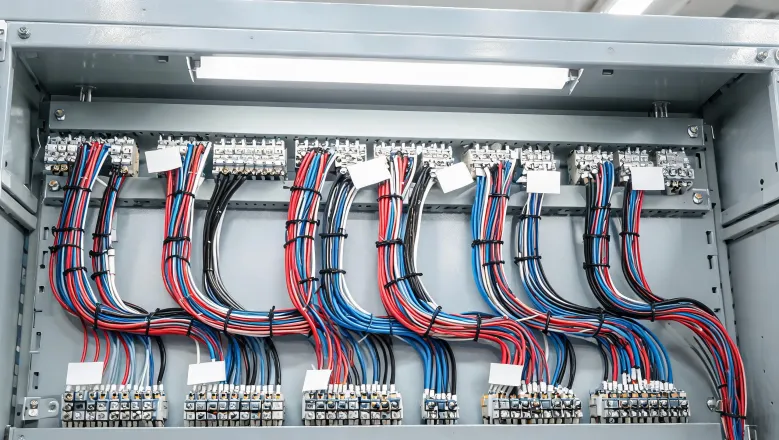
But if you're bundling wire runs inside a NEMA 1 enclosure in a warehouse, a UL-listed nylon 6/6 tie from a reputable non-Panduit supplier will do the same mechanical job. The honest limitation: I can't tell you exactly where the line sits between "overkill" and "insufficient" for your application—that depends on load, temperature, UV exposure, and vibration. What I can tell you is that in our own assembly lines we use Panduit for anything that leaves the building as a finished product, and generic certified ties for internal wire management where no one will ever see them again.
That's a cost-per-risk decision, not a brand loyalty decision.
Q4: Panduit cable tie mounts—what should I be checking beyond the datasheet?
Three things the spec sheet usually doesn't tell you:
Adhesive. The mounting base is often the weak point, not the tie. Rubber-based adhesive holds up fine indoors at room temperature. If you're going into a car engine bay or a cold storage room, you need acrylic or a mechanical fastener, and the datasheet won't spell that out for you.
Substrate. We ran a blind pull test on a batch of mounts applied to powder-coated steel vs. bare aluminum. Failures on powder coat happened at roughly half the load. (I should add that we tested at 60°C—room temperature results were closer.)
Direction of load. Mounts are rated for pull-through in one axis. Off-axis loads, like a wire bundle pulling sideways, cut the effective rating significantly.
My experience here is based on about 200 mount applications across enclosure and cabinet work. If you're doing aerospace or marine, your failure modes will differ from what I've seen.
Q5: How do I evaluate an enclosure supplier without getting snowed by their pitch deck?
Ask for three things, in this order: first-article inspection reports from the last 6 months, a list of rejections and root-cause fixes, and the name of a customer who's been with them longer than 3 years. Any supplier who can't produce all three fast is telling you something.
Then do a blind sample. Two identical spec's boxes from two suppliers, no labels, and have your own team run your checklist. In our last blind test, 71% of our reviewers picked the mid-priced supplier over the cheapest one as "more professional" based purely on hinge feel and paint consistency. That's not science, but it's reality.
Q6: One supplier for both enclosures and cable management—smart or risky?
Usually smart, with one caveat. Consolidating means one PO, one shipping window, one person to call when something's wrong. And when the box and the ties and mounts are engineered to fit each other—which is one reason Panduit's ecosystem still wins on spec—you spend less time chasing compatibility issues.
The caveat: when a supplier is strong in one category and just resells the other, quality drifts. Ask which product line they actually manufacture and which they source. If the answer is vague, expect the resold line to be the one that shows up late or off-spec.
At least that's been my experience across the last 4 years of vendor reviews.
Q7: When would you tell me not to use a private label or OEM enclosure program?
The counterintuitive one—and the one I'd push back hardest on: don't do it if your customer is buying your brand for price reasons, not identity reasons.
Private label works when buyers are paying a premium for your name. If your customers would happily switch to whoever's $4 cheaper next quarter, you're spending tooling money to reinforce a brand they don't care about. That's the 20% case, and it's more common than the industry likes to admit.
We walked away from two private label opportunities in 2024 for exactly this reason. One of them came back a year later and became a good standard-product customer. The other didn't, and I still think we made the right call.
Bottom line: private label is a commitment to a brand story. If you don't have one to tell, box stock and a good spec are the more honest answer.