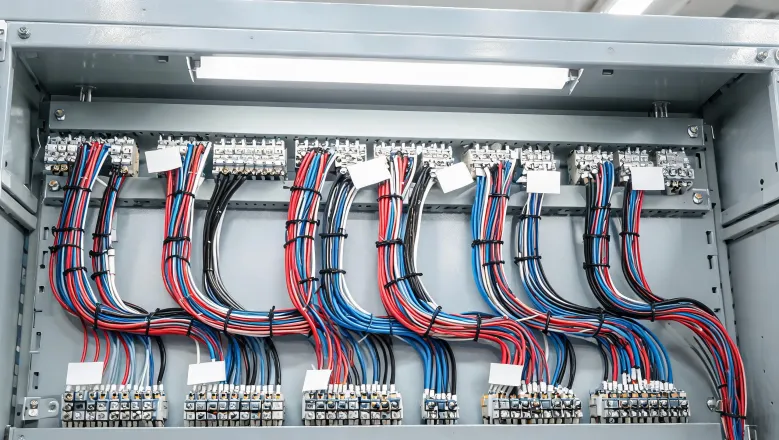
It was a Tuesday afternoon when the pallet arrived. My colleague signed the delivery slip without looking at the boxes. An hour later, our shop foreman walked into my office holding a white bag and said four words I've come to dread: "Is this what you meant?"
Inside were 10,000 Panduit cable ties and 5,000 Panduit cable tie mounts. And the mounts were wrong. Not slightly wrong. The kind of wrong that stops a production line.
That was September 2023. The whole episode cost us around $2,800, counting rework, expedited shipping, and lost production time. But the bigger cost was credibility with a customer we'd been trying to land for a year.
Let me back up and explain how we got there, because the mistake wasn't what you'd expect. It wasn't the enclosures. It wasn't the cable ties themselves. It was the mounts — and our assumption that "standard" meant something.
It Started with a "Simple" Order
We manufacture electrical enclosures and junction boxes for regional OEMs. We also stock internal wire management materials — Panduit cable ties, mounts, markers, the whole ecosystem — so we can offer a complete package. That's the one-stop idea, and it's a good one in theory.
The order was for a packaging machinery OEM building 23 control panels. Each panel needed a NEMA-rated enclosure, Panduit cable ties for the wire bundles, and mounts to hold those bundles in place.
"Just get the standard ones," the project engineer said. "The ones we always use."
And that's where the trouble started. We were using the same words but meaning different things. I said "standard." He heard "whatever you used on the last job." Our last job was stationary equipment in a climate-controlled room. This job was a vibrating packaging machine in a warm factory environment. Same wires, same ties, completely different reality.
It's Tempting to Oversimplify Cable Ties
It's tempting to think one cable tie is basically the same as another, and a mount is just a piece of sticky-backed plastic. That's how I approached the order, and it cost me.
The reality: Panduit cable tie mounts come in two basic families — adhesive and screw mount — and choosing between them requires knowing what the tie will experience. Adhesive mounts are fine for clean, static, temperature-controlled environments. Screw mounts are for applications with vibration, moisture, or temperature swings. On a packaging machine, adhesive mounts will eventually let go. Not maybe. Eventually.
There's also the material story. Standard nylon 6.6 Panduit ties are rated for continuous use up to about 85°C (185°F). That's fine for most control panels. But if the enclosure sits near heat sources, or the factory floor runs hot in summer, heat-stabilized ties are the correct call. In September 2023, our specification review process was essentially "do we have any in the drawer?" That wasn't a process. It was a hazard.
The Decision That Seemed Fast at the Time
Here's how we actually got the order wrong.
We had a deadline. The customer had already waited four weeks. The production schedule was tight. When I reached our electrical distributor, they offered the PLT series with adhesive mounts — in stock, ready to ship. I had two hours to confirm before the production freeze, and I knew in my gut we should double-check the application details before committing.
But the pressure was real. The customer was waiting. The schedule was fixed. So I made the call: "Send it."
The vendor's quote even listed the item descriptions clearly. But I didn't read carefully. I knew I should verify the mount type, but thought, "What are the odds? We'll mount these on the back panel. They'll hold." The odds caught up with me when the first vibration test produced loose harnesses — and the tech's report said the adhesive-backed mounts had started peeling.
That was the moment I understood: five minutes of verification could have prevented five days of correction.
Five minutes of verification beats five days of correction.
The Second Problem Nobody Saw Coming
While we were reworking the mounts, a separate issue surfaced. The customer's spec called for NEMA 4X enclosures — meaning corrosion-resistant, suitable for washdown environments. Our proposed box was a mild steel model rated NEMA 12.
For context, NEMA 12 is a respectable rating for indoor use against dust and dripping liquids. But NEMA 4X is a different product family: typically stainless steel or fiberglass, with a different gasket system and a design intended for hose-down and corrosive locations. We quoted the part number the buyer listed, but didn't trace it back to the actual environment. The inspector caught it within two hours of the first delivery arriving on site.
To be fair, we weren't trying to cut corners. The confusion came from a shortened part number on the inquiry. But "we assumed" is not a comforting phrase when you're standing in front of a customer's inspector.
Two problems on one order. Both preventable. Both a direct result of skipping the verification step.
What the New Checklist Looks Like
I'm not going to pretend we suddenly became a Six Sigma operation. We're a small team. But after that September, I sat down and turned our experience into a simple pre-order checklist. Five questions, every wire management order, no exceptions:
- What is the operating environment? Temperature range, vibration, moisture, chemical exposure. This drives the tie material, the mount type, and the enclosure rating.
- What mount type is actually required? Adhesive, screw, or push-mount? For anything that moves, vibrates, or gets hot, default to screw mounts unless there's a reason not to.
- What's the exact Panduit part number? Not "the usual one." Not "closest match." The exact number from the drawing or a confirmed reference. If it's not on the drawing, ask.
- Does the enclosure rating match the spec? NEMA 4X is not NEMA 12. Confirm the rating before quoting, not after delivering.
- What did the last mistake teach us? Our checklist ends with a space for notes from the previous job. It's the most uncomfortable question and the most useful one.
If someone handed me an electrical cabinet catalog and asked for a specification guide, I'd point them to this one-page checklist, worn at the edges and covered in coffee stains.
The Math Behind Prevention
Let's talk numbers, because "prevention is cheaper than correction" only means something with a price tag attached.
The original order for 10,000 ties and 5,000 mounts was approximately $1,850 (based on our distributor's quote, September 2023; commodity plastic pricing has moved since then — verify current rates before budgeting). The rework cost $890 for screw mounts and replacement material. Expedited shipping ran $350. Lost production time: roughly $1,560. Combined, the "cheap fix" cost around $2,800 — roughly 150% of the original order value.
Why does this matter? Because in our business, the margin on the enclosure side doesn't absorb surprises like that. One preventable mistake can wipe out the profit on an entire mid-sized order. The checklist isn't bureaucracy for its own sake. It's the cheapest insurance policy we've found, and in the 18 months since I started using it, we've caught at least seven specification mismatches before they became production problems.
If You Take Anything from This Story
Here's what I'd say to anyone sourcing cable ties, mounts, or enclosures in bulk:
- The part number is the contract. Verify it against the datasheet before you commit. Panduit publishes full specifications for every tie and mount on their website — temperature range, tensile strength, material, approvals.
- Match the mount to the environment, not the catalog. Adhesive mounts are a convenience, not a permanent solution for moving equipment. When in doubt, screw mounts.
- Confirm the enclosure rating in writing. NEMA ratings are defined and published by the National Electrical Manufacturers Association (nema.org). Familiarize yourself with the differences between NEMA 1, 12, 4, and 4X before you quote an OEM order. Current standards are available directly from NEMA; verify revisions as they're updated.
- Get the confirmation in writing. A two-line email confirming part numbers, quantities, and delivery dates is the cheapest insurance in procurement. I learned that after September 2023. Now it's non-negotiable.
Granted, all of this sounds obvious in hindsight. That's the nature of most mistakes — they're obvious after they cost you something. But the less obvious part is how easy it is to skip a five-minute verification when a customer is waiting and your calendar is full. I've done it. I paid for it. And I'm writing this in the hope that someone else reads it before they place their next order — not after.
One more thing: I don't believe in perfection. We'll still make mistakes. But now we make them once, write them down, and don't repeat them. To me, that's what preventing problems actually looks like in a small manufacturing operation.