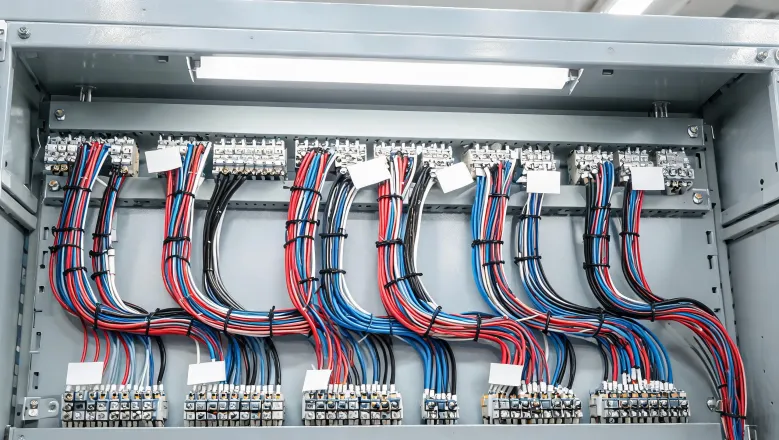
I've been handling enclosure and cable management orders for eight years. And I'll say this upfront: if you're shopping for electrical enclosures or cable ties based on lowest unit price, you're about to lose money in ways your spreadsheet won't show you.
Not because cheap products are inherently bad. Because the cost shows up somewhere else — in rework, in missed ship dates, and in what your customer thinks when they open the box. I've paid that tuition three times. Here's what I learned.
What Your Buyer Notices in the First 10 Seconds
Nobody reads the spec sheet first. They open the crate and look at the things they can feel:
- The hinge action on a cabinet door — does it drop or does it glide?
- The bend radius on the corner seams — sharp or clean?
- The click of a cable tie — does it lock crisp or does it grind?
- The edges on a cable tie mount — smooth or flashing?
That's the whole evaluation. Takes maybe two seconds, and the customer has already decided what kind of supplier you are.
In Q3 2021, we ran a side-by-side test on this. Same enclosure, two different cable tie suppliers — one premium, one generic at 40% less. The panels came back from the field with identical performance data. But the installer feedback was not identical.
On the premium ties: "Good grip, no slip."
On the generic ties: "These feel cheap."
Same function. Different perception. That difference followed us for three more orders.
The Compliance Question You Can't Skip
Here's where I have to draw my own boundary: I'm not an electrical engineer or a compliance officer. For technical rulings on UL 508A or NEMA 250 enclosure ratings, you should consult someone whose job that actually is. What I can tell you is the procurement-side reality:
Every customer who has walked away from us in eight years — all four of them — left because of a compliance issue that surfaced after delivery. Not price. Not lead time. Compliance.
That 40% cheaper cable tie rarely carries a UL 94 V-0 rating with traceable batch documentation. The discounted enclosure often can't produce the test reports that actually match the NEMA rating on the label. And a private-label enclosure with your logo on it means you own that mismatch when it surfaces.
Per NEMA 250 (Enclosures for Electrical Equipment, 1000 Volts Maximum), enclosure type ratings apply to specific environmental conditions and must be verified through testing. The label alone proves nothing — request the test documentation for the exact model and batch.
Pricing on this stuff fluctuates, so treat any number as a snapshot (verify current pricing with your suppliers). But the direction of the gap is consistent: a UL-listed cable tie runs roughly 2–3x the unit price of an unlisted generic (based on quotes we collected in January 2025 from three wholesale sources).
When you do the math on what a single rejected shipment costs — replacement, reshipment, customer credit, and the phone call you have to make — that premium isn't a premium anymore. It's insurance.
OEM vs Private Label Enclosures: You're Asking the Wrong Question
This is the one I get asked by almost every distributor I work with: "Should we go OEM or private label?"
And it kept me up at night back in 2022, when we were deciding whether to launch our own branded enclosure line. On paper, private label made sense — 15–20% better margin, our name on the box, direct control over positioning. But my gut said we didn't have the technical infrastructure to back it up.
We went private label anyway. And then a customer asked for the UL file number on our branded enclosure, and I had to spend three days chasing our manufacturer for documentation that should have been in our files before the first unit shipped.
Here's the distinction that actually matters:
- OEM — the manufacturer's brand carries the compliance responsibility. If something fails a spec, the brand owner is on the hook. You're a channel.
- Private label — you become the brand. You answer for the spec sheet, the certificates, the warranty claims, and the customer's phone call when something doesn't match.
So the real question isn't "which is cheaper." It's: do we have the technical team and documentation infrastructure to own the compliance story if we put our name on the box?
If the answer is no, stay with OEM. Better margin with a compliance hole in it isn't margin — it's a liability you haven't priced yet.
What Nobody Tells You About the Second Cost
Let me put actual numbers on this, because I've kept the records:
In 2022, we switched to a cheaper enclosure supplier to save 11% per unit on a 600-unit order. Here's how that played out over six months:
- First shipment: 8% of units had powder coat defects. Rework = $640 and a 5-day delay.
- Second shipment: cable tie mounting holes were off-spec. Line installers had to drill out 220 units. Lost 2 days of assembly time = roughly $1,100 in labor.
- Third shipment: Customer's QA team rejected 34 units for door alignment. Replacement + freight = $890. Plus the customer started auditing every subsequent shipment.
The 11% unit savings on 600 units? Around $2,400. The cost of the problems? Over $2,600 before factoring in the ongoing trust deficit with that customer.
Never expected the math to flip that fast. Turns out the unit price is only the entry fee — the real cost is the risk you're buying with it.
"But Our Customers Don't Care About Details"
I hear this one a lot. And I used to believe it, until a customer's purchasing manager told me — off the record, over lunch — that our competitor's enclosures felt "more serious" in the demo room. He couldn't articulate why. He just knew.
He was reacting to the hinge tension, the tie mounts, the paint finish. He didn't know he was evaluating those things. But he was.
The other objection: "We have to be price-competitive or we get no orders."
Fair. But competitive against what? If your entire customer base is buying on unit price alone, you're not in a product business — you're in a commodity business. That's a different strategy with different rules, and cutting quality to stay in it is a race to the bottom that you eventually lose anyway.
What I'd push back on is the assumption that every customer is that kind of buyer. In my experience, maybe 30% are pure price shoppers. The other 70% will pay a premium for consistent quality, documented compliance, and a supplier who doesn't make them chase paperwork.
The Point I Keep Coming Back To
Cheap isn't the problem. Not knowing why it's cheap is the problem.
If your supplier can show you the UL file, the batch traceability, the material certificate, and the same spec sheet for your private-label version that they show for their own brand — then cheap is fine. That's called efficiency.
But if they can't? You're not saving money. You're borrowing against a bill that comes due the first time a customer checks.
Three things to verify before your next enclosure or cable tie order:
First, the compliance documentation for the exact model and batch. Second, the true landed cost including rework probability — ask your team what percentage of shipments from that supplier have required some kind of correction in the last 12 months. Third, who owns the brand if something goes wrong.
Answer those three, and the price conversation gets a lot simpler. Because then you're not comparing quotes. You're comparing risk.
Prices cited in this article are from vendor quotes collected January 2025 and are for general reference. Verify current pricing and compliance documentation directly with your suppliers. For technical or regulatory rulings, consult a licensed professional.