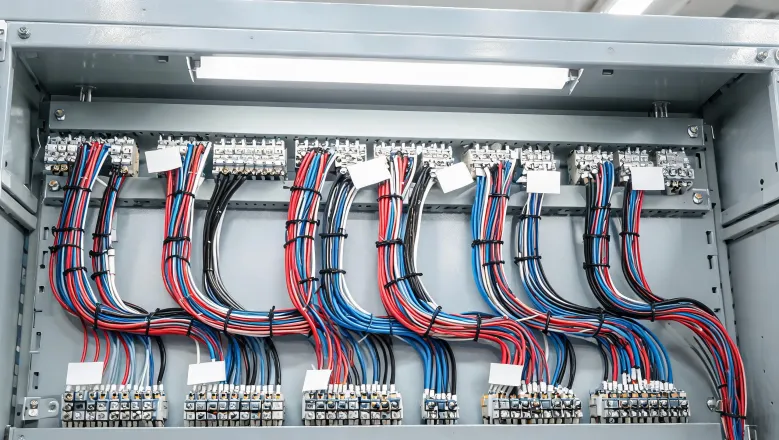
“Can you come look at something?” That message from our shop floor lead never arrives with good news.
I followed him to the assembly bay, where a new electrical enclosure sat on the workbench. It looked exactly like the sample: clean powder coat, solid door, matching latches. Then he pointed to the back panel and asked, “Where are we supposed to put these?” He was holding a package of Panduit cable tie mounts and a bag of Panduit cable ties.
I looked at the back panel. No punched mounting pattern. No dimples. No location grid. It was a beautiful box, completely unprepared for the way we build.
Quick background: I’m the office administrator for a 28-person company that designs and assembles control panels and small electrical cabinets for OEM customers. I manage about $350,000 in annual purchasing and report to both operations and finance. I don’t have an engineering degree. I have learned this role by making mistakes, and this one starts with a legitimate-looking quote.
If you’re searching how to evaluate electrical enclosure manufacturers, you will find advice about NEMA ratings, material thickness and lead times. All of that matters. But nobody tells you to consider the small parts that make the box usable in your plant. Those details are where the money hides.
The Quote That Looked Like a Win
Back in 2023, the regional fabricator that had supplied our enclosures for years closed its doors. We had about five weeks to qualify a new electrical enclosure manufacturer and get parts moving for a customer order.
I sent the same detailed request to three candidates. One quoted noticeably less than the other two. It wasn’t an absurd lowball—just low enough to look smart. I thanked the other companies and placed a pilot order. My logic was simple: an enclosure is a box. If it has the right dimensions and right rating, what could go wrong?
Plenty, as it turned out.
When I first started managing vendor selection, I assumed suppliers operated in a standardized world. If you say “600 x 600 x 250 mm enclosure, NEMA Type 12, mounting plate,” every manufacturer pictures the same product. That assumption was wrong.
Our shop standard is to secure wire bundles with Panduit cable ties. To keep them serviceable, we attach Panduit cable tie mounts to the back panel at regular intervals. It gives us straight wire runs, easy replacement, and a consistent finish. None of that was on the drawing I sent. I had written “wire management per standard practice” in one email, which was lazy and vague.
The manufacturer built what we specified, not what we had in our heads. That is fair. If you don’t specify the mounting pattern, you can’t expect to receive it.
The first sample enclosure arrived and looked correct. Our engineers checked the door alignment, cutouts, and finish. We didn’t wire anything into it. We didn’t install a subpanel or try to route a single cable. It sat on a bench looking nice, and everyone signed off.
What the First Production Batch Taught Me
The problem showed up in the first production lot. Twenty enclosures arrived, and each one had a clean back panel with no provisions for the Panduit cable tie mounts. When our assembly lead saw the batch, he didn’t yell. He simply took a photo, walked over to my desk, and asked how we planned to fix it.
We drilled the holes ourselves. Not the end of the world, but not free, either. Every cabinet had to be laid out, masked, drilled, deburred, cleaned, and touched up. That cost us roughly three days of technician time and about four times the savings from the lower quote. More importantly, it delayed our first customer-facing assembly by a week. I was not popular.
Could we have used adhesive-back Panduit cable tie mounts and skipped the holes? On a clean panel, maybe. But our work instructions and repair practices call for screw-mount hardware. I didn’t want to change a proven assembly method just because I didn’t ask the right supplier question.
The supplier wasn’t dishonest. When I called, they pointed out, correctly, that their quote included the enclosure as specified. The fix was straightforward in the future—add the hole pattern to the drawing and the RFQ. It just should have happened before the purchase order, not after.
How to Evaluate Electrical Enclosure Manufacturers: What I Check Now
Since that batch, I’ve changed how I run every enclosure search. If you want the short answer to how to evaluate electrical enclosure manufacturers, here it is:
- Describe assembly, not just the enclosure. I now include a section called “Shop floor assumptions.” It covers what happens after the box arrives: mounting panel installation, cable tie mount locations, ground lug placement, door closer position, vents. If a manufacturer wants to negotiate those details, good. That conversation belongs before the quote.
- Put cable management accessories in the RFQ. If you use Panduit cable tie products, name them. Ask exactly how the accessory package will be sourced and delivered. Have I become the person who asks why a different cable tie arrived when the drawing said Panduit cable tie? Yes. That is because my name is on the order. Specification changes should be approved, not assumed.
- Ask for compliance documentation that matches the actual product. If the enclosure carries a UL/cUL mark, ask for the documentation for that exact model. If the application involves cable ties, know what standard is being cited—often UL 62275 in electrical installations. You don’t need to be an expert, but you need to know enough to catch a bad substitution.
- Build a sample the way you build the final product. Don’t just inspect the bare enclosure. Mount the panel, fit the cable management, install a few components, and close the door. That is the step that would have caught our missing Panduit cable tie mount pattern before we ordered twenty.
- Watch how the manufacturer answers questions. A good electrical enclosure manufacturer asks about application, environment, grounding, and clearance. A quote with no questions means they are not thinking about how you will use the box. That might be acceptable for a simple standard enclosure, but it’s not enough for OEM work or custom details.
A Note for Small Buyers
Our company is not a large OEM. We might buy twenty enclosures at a time before a design change, and some manufacturers treat that order as small. I’m not offended by honest minimums or realistic lead times. But if a supplier makes you feel like a nuisance for asking about cable tie mounts or custom holes, walk away.
The best enclosure partner I have is the one who answered our 20-unit pilot questions with engineering drawings and a revised quotation. That supplier may not have been the lowest first bid, but they understood that a small order today can become a regular account tomorrow. Small doesn’t mean unimportant. It means the relationship has room to grow.
The Part Most Checklists Miss
I don’t want to overstate the lesson, so I’ll be precise. Choosing the wrong electrical enclosure manufacturer was not a catastrophe. It was a delay, a budget hit, and a reminder that purchasing is about process, not just product.
Let me be clear: price still matters. It matters a lot. But the real price of an enclosure includes what happens after it arrives. If you’re evaluating electrical enclosure manufacturers now, include the small stuff: wire management, mounting patterns, cable tie mounts, and every other detail your shop will need later.
That package of Panduit cable tie mounts ended up being an expensive consultant. It also made me a better buyer. The small parts of a build are usually the ones that make it smooth—or stop it cold.