-
Do cable ties actually affect enclosure compliance?
-
What's the difference between nylon 6.6 and nylon 12 cable ties?
-
What's the deal with Panduit cable tie mounts?
-
How do I choose Panduit cable tie size and tensile strength?
-
What should I look for when buying electrical enclosures wholesale?
-
What are the actual UL/NEMA requirements for electrical cabinets?
-
What about private label enclosures and cable ties?
-
How do I evaluate a cable tie or enclosure supplier?
-
Do I need to worry about the color of cable ties?
-
Cable ties are a small part. But they're not a dumb part.
If you buy electrical enclosures or cabinets in volume, you've probably asked yourself four or five questions about the cable ties inside them. Maybe you're speccing an OEM build. Maybe you're sourcing for a distributor. The thing is, the answers matter more than most people think.
Here are the questions I end up asking on almost every order. Some are standard. One or two will surprise you.
Do cable ties actually affect enclosure compliance?
Yes, but probably not in the way you'd expect.
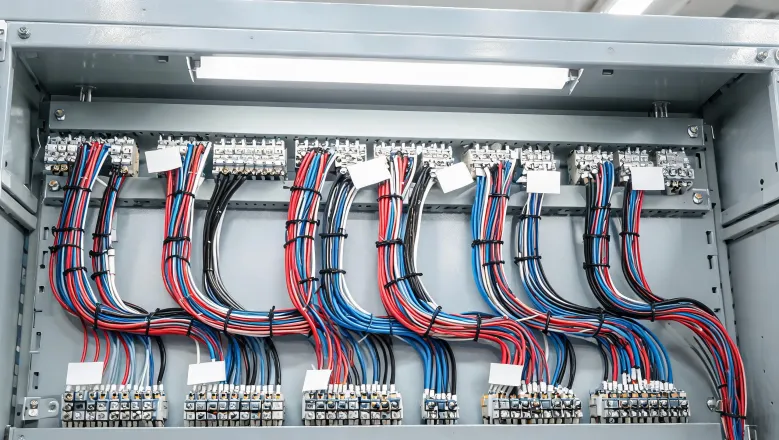
The enclosure itself usually carries the main rating—UL 508A for industrial control panels, NEMA/Type ratings for environmental protection, that kind of thing. But how you route and secure wiring inside that enclosure can absolutely become part of a compliance review, especially when a customer or inspector opens the door.
In our Q1 2024 audit, we flagged 14% of first-article panels because internal wiring was cinched too tight or routed against sharp metal edges. Not because the enclosure was wrong. Because the cable management was sloppy.
Cable ties aren't just organization. They're strain relief. They keep conductors away from moving parts and sharp edges. And in some UL evaluations, how wire bundles are supported matters.
So when we buy Panduit cable ties in bulk, we treat them as part of the compliance conversation. Not the whole conversation, but a real one.
What's the difference between nylon 6.6 and nylon 12 cable ties?
This one comes up a lot because Panduit offers both.
Standard cable ties are typically molded from nylon 6.6. It's strong, stiff, and holds its shape well. It's also susceptible to moisture absorption, which can degrade mechanical properties over time in humid environments.
Nylon 12 absorbs less moisture. It's more flexible. It holds up better outdoors and in chemically aggressive environments. But it's usually more expensive.
Our rule of thumb:
- Indoor, controlled environment: nylon 6.6 is fine.
- Outdoor, high humidity, or chemical exposure: nylon 12 is worth the premium.
- Plenum-rated areas: check the specific material rating.
I've seen spec sheets claim "outdoor rated" without mentioning material type. That's a red flag. Get the material on paper.
What's the deal with Panduit cable tie mounts?
Good question, because the mount matters as much as the tie.
Self-adhesive mounts are convenient. But "convenient" and "permanent" are different things. Adhesive mounts work well for light bundles and vertical surfaces where shear load is minimal. They fail when you pull the tie sideways or mount them to dusty, oily, or textured surfaces.
Screw-mount or push-mount styles are better for heavier bundles or vibration environments. Inside an enclosure that's going through shipping, temperature cycling, and maybe a forklift ride, a screw mount is cheap insurance.
One thing I learned the hard way: check the mounting hole pattern before you finalize the enclosure layout. We had a batch of 4,000 subplates where the tie mount holes were drilled 2 mm off from the customer's preferred Panduit mount. Not a huge deal, but it made the assembly line slower for a week.
The extra cost of a screw mount is small. The rework cost of a failed adhesive mount is not.
How do I choose Panduit cable tie size and tensile strength?
Start with bundle diameter, then work backward.
Panduit cable ties are categorized by length and tensile strength. A standard 8-inch tie handles bundle diameters up to roughly 2 inches. A 14.5-inch tie handles closer to 4 inches. Tensile strength ranges from 18 lb for light-duty ties to 120 lb or more for heavy-duty versions.
But here's the mistake I see buyers make: they spec the longest, strongest tie "to be safe." Wrong.
Too-long ties leave excess tail, which gets trimmed by installers who don't always trim cleanly. Those sharp tails can nick neighboring wires. Too-wide ties can be over-tensioned on small bundles, damaging the insulation before the tie locks.
Match the tie to the bundle. Leave a little room, not a lot.
For 90% of enclosure wiring, a 4-inch or 8-inch tie rated at 18 to 50 lb will get the job done. Heavy-duty ties are for structural applications—not for bundling 12 AWG THHN wire in a control panel.
What should I look for when buying electrical enclosures wholesale?
Let me flip this around, since it's actually relevant to the cable tie question.
If you're buying enclosures as a distributor or OEM, don't start with the enclosure. Start with what's going inside it. Cable ties are part of that. So are DIN rails, wire ducts, terminals, and access space.
We evaluate enclosures on four things:
- Material gauge and build quality. Thinner steel is cheaper upfront and painful later.
- IP/NEMA rating path. Can the enclosure actually achieve the rating with the knockouts and glands you need?
- Subpanel and mounting geometry. Is there room for the cable management you specified?
- OEM/private label flexibility. Can you get your logo and part number printed? What's the minimum order?
On the last point: a lot of buyers underestimate how important private label options are for their own brand. If you're reselling enclosures, your customer shouldn't see the manufacturer's label and go straight to Google. Private labeling changes that.
It costs a bit more per unit. On a 500-unit order, it can be the difference between being a pass-through vendor and being a brand.
What are the actual UL/NEMA requirements for electrical cabinets?
I'll be honest: I'm not a certifying engineer, and I don't play one in articles. But after reviewing a fair number of submittal packages, here's the practical side.
For industrial control panels, UL 508A is the standard that comes up most. It covers spacing, component ratings, wiring methods, and short-circuit current rating (SCCR). NEMA ratings like Type 1, 3R, 4, 4X, and 12 are about environmental protection—indoor, outdoor, water, corrosion.
Two things buyers get wrong:
First, a NEMA Type 4 enclosure doesn't automatically make the whole panel Type 4. Every knockout, gasket, gland, and bolt affects the rating. If your cable entry strategy is sloppy, the rating is fiction.
Second, UL 508A isn't just about components. It's about how they're assembled. That includes wiring methods. Stranded wire, bending space, and even cable ties can come into play. A 50-cent cable tie isn't a compliance device, but using it wrong can be a mark against you in an evaluation.
Morale of the story: don't treat the standard as someone else's problem.
What about private label enclosures and cable ties?
This is one of those questions people don't ask until they're already committed to a supplier.
Private label works differently for enclosures than for cable ties.
Enclosures are simple. Steel box, laser-cut holes, powder coat. Plenty of manufacturers can put your brand on the label, or even build to your drawing. The MOQ tends to be manageable, and customization is common.
Cable ties are more complicated. Molded components require tooling, engineering, and strict raw material control. A tiny variation in mold temperature changes the mechanical properties. If a supplier offers Panduit-compatible cable ties with your private label, ask to see their QC data for tensile strength, flammability rating, and batch traceability.
I once reviewed a private label cable tie that looked identical to the standard product. The material was slightly off, the locking teeth were duller, and the tensile strength was roughly 30% lower. Nothing in the sales material mentioned it. The samples passed. The production run did not.
If you're going the private label route, enforce the same spec you'd hold the branded product to. Otherwise the brand damage is yours, not the factory's.
How do I evaluate a cable tie or enclosure supplier?
Start with documentation.
Ask for the following, in writing:
- Mill certificates / material certifications
- Test certificates from a recognized lab, not just internal QC
- Batch traceability system and recall procedure
- Photographs or reports from third-party inspections
- Clear lead times, including buffer days for inspection
Then order a small lot. I know that sounds like extra work, but a 100-unit trial tells you more than a 50-page brochure.
We did this with a new enclosure supplier in 2023. The certificates were perfect. The first trial batch had misaligned door hinges and paint overspray on the interior. One sample arrived with a dent deep enough to miss the gasket channel entirely.
We rejected the batch, the supplier redid it, and the second attempt was acceptable. We put the inspection procedure into our contract. That's the real deliverable.
Don't skip the trial. It's the cheapest mistake-prevention tool you have.
Do I need to worry about the color of cable ties?
From a functional standpoint, natural nylon and black nylon perform about the same in most indoor applications. Black has UV stabilizers, so it handles sunlight better. Natural nylon is easier to inspect because you can see artifacts and stress marks in the material.
For brand-focused buyers, Panduit cable ties are available in multiple colors. If your enclosure has a specific look—or your private label identity depends on it—Panduit's color options are a clean way to make that happen.
That said, I wouldn't pay a large premium for color in a standard interior application. White or black is almost always acceptable. But on a customer-facing product? Color can actually be worth something. Perception is part of quality. When I switched a display enclosure line from black to white cable ties to match the interior paint, the visual difference was immediate. It just looked cleaner. Cost increase was negligible.
People notice. Even when they can't say what's different. That's what brand perception is.
Cable ties are a small part. But they're not a dumb part.
If I've learned anything from reviewing orders and inspecting incoming batches, it's that the small stuff reveals how a supplier thinks. Cable ties are cheap. Mounts are cheap. But when they fail, the cost isn't the 15 cents you paid. It's the rework. The delay. The conversation with your customer.
So no, I don't agonize over whether to use Panduit over a generic tie. What I do is care about material specs, mounting strategy, and consistency across the whole supply chain.
Get those right, and the rest is straightforward.